Many people start scuba diving as a hobby. Before long, they find themselves spending every possible moment underwater and wondering if they could turn their passion into a career. If that sounds familiar, you may be asking yourself how to become a scuba diving instructor.
The good news is that becoming a dive professional is a structured process. Whether your goal is to work in tropical destinations, lead dive trips around the world, or simply share your love of the ocean with others, there is a clear path from beginner diver to instructor.
This guide explains each stage of the journey and what you can do to give yourself the best chance of becoming a successful diving professional.
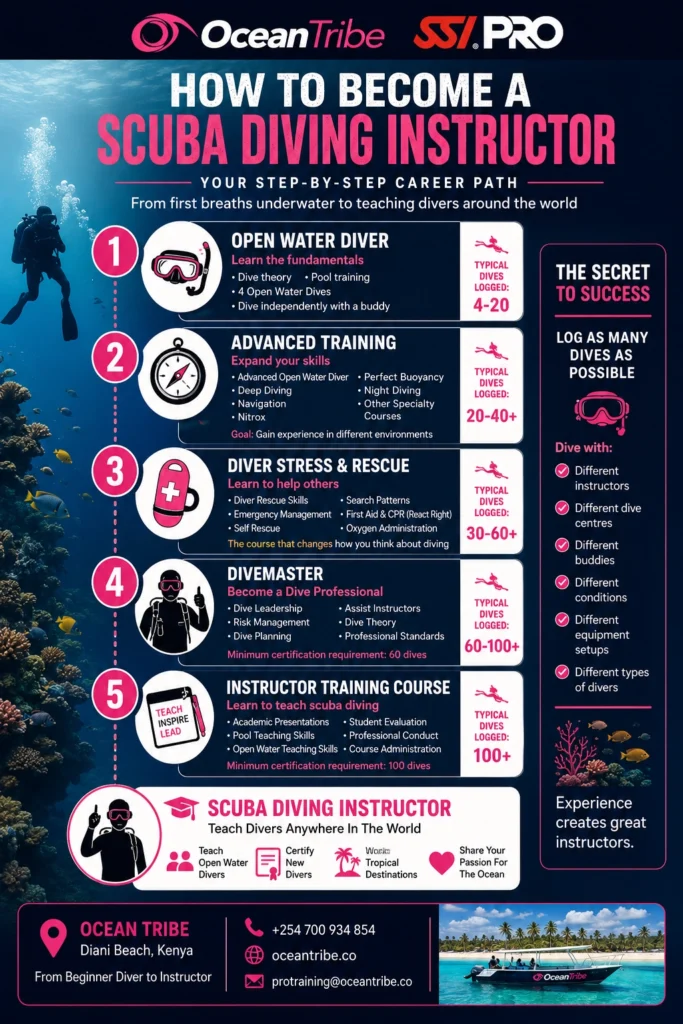
Step 1: Start With Your Open Water Diver Certification
Every scuba instructor begins as a beginner.
The first step is earning your Open Water Diver certification. This entry-level qualification teaches the fundamental skills needed to dive safely and independently with a buddy.
During your course you will learn:
- Dive equipment assembly and use
- Basic dive planning
- Buoyancy control
- Underwater communication
- Safe ascents and descents
- Dive safety procedures
Most Open Water Diver courses include academic learning, confined water training, and four open water training dives. At Ocean Tribe you get 2 more experience dives too, to really get you started.
Once certified, you can dive independently with a buddy within the limits of your training.
Focus on Experience, Not Just Certification
Many new divers rush to the next course. Instead, spend some time enjoying diving and building confidence.
Different dive sites, conditions, and buddies will help develop skills that cannot be learned in a classroom.
Step 2: Build Experience Through Advanced and Specialty Training
After earning your Open Water Diver certification, the next goal is to expand your skills and experience.
Many divers choose to complete an Advanced Open Water Diver course These courses are an excellent way to experience several different types of diving under instructor supervision.
However, it is important to understand that you do not necessarily need an Advanced course to continue your development. In fact, many future dive professionals choose to complete full specialty courses instead.
Specialty training allows you to spend more time developing specific skills and gaining additional dives in each area. Popular specialties include:
- Deep Diving
- Underwater Navigation
- Enriched Air Nitrox
- Night & Limited Visibility
- Wreck Diving
- Perfect Buoyancy
- Computer Diving
- Search and Recovery
- Marine Ecology
While an Advanced course provides a great introduction to these activities, individual specialty courses often provide more comprehensive training and a deeper understanding of the subject.
For aspiring dive professionals, the goal should not simply be collecting certifications. Instead, focus on becoming a well-rounded diver with experience in a variety of environments and conditions.
Whether you choose an Advanced Open Water programme, specialty courses, or a combination of both, the most important thing is to keep diving, learning, and building experience.
Why Specialty Courses Can Be Valuable for Future Instructors
As you progress towards professional levels, you’ll eventually teach and dive alongside people with a wide range of interests and goals. Having experience in multiple specialty areas helps you become a more knowledgeable and versatile dive professional.
A diver who has completed courses such as Deep, Navigation, Nitrox, Night, and Wreck Diving will often have a broader understanding of diving than someone who has simply completed the minimum certification requirements.
The more varied your diving experience becomes, the stronger your foundation will be when you eventually enter Divemaster and Instructor training.
Step 3: Learn Rescue Skills
Before becoming a dive professional, you must learn how to help others.
This is where Diver Stress & Rescue and React Right training become essential.
Many divers describe this as the most important course they have ever taken.
You will learn:
- Diver self-rescue techniques
- Recognising stress in divers
- Emergency management
- Search techniques
- Rescue scenarios
- Accident response
- CPR and First Aid
- Oxygen administration
The course shifts your mindset from focusing only on yourself to becoming aware of the safety and wellbeing of everyone around you.
This is a critical transition for anyone considering a professional diving career.
Step 4: Become a Divemaster
The Divemaster programme is where you move from recreational diver to dive professional.
As a Divemaster candidate, you will learn:
- Dive leadership skills
- Dive planning and organisation
- Risk management
- Professional conduct
- Environmental awareness
- Assisting instructors during courses
- Supervising certified divers
You will also develop a much deeper understanding of diving theory.
Gain Real-World Experience
The best Divemasters are not simply people who completed a course.
They are people who have spent time:
- Leading dives
- Working with different instructors
- Assisting with student training
- Solving problems
- Interacting with customers
- Experiencing different conditions
This experience is what prepares you for instructor training.
Step 5: Complete an Instructor Training Course
The next stage in how to become a scuba diving instructor is the Instructor Training Course (ITC).
This programme teaches you how to become an effective educator rather than simply a skilled diver.
You will learn:
- Teaching techniques
- Student evaluation methods
- Academic presentations
- Confined water teaching
- Open water teaching
- Risk management
- Professional standards
- Course administration
Many candidates enter the ITC believing it is all about demonstrating diving skills. In reality, teaching ability, communication, organisation, and professionalism are equally important.
Instructor Evaluation
After completing the Instructor Training Course, candidates typically attend an Instructor Evaluation.
This final assessment ensures that new instructors meet the required professional standards before certification.
Once successful, you become a certified scuba diving instructor and can begin teaching new divers.
Step 6: Dive, Dive, and Dive Some More
There is one step that is often overlooked when discussing how to become a scuba diving instructor.
Simply dive as much as possible.
Log dives with:
- Different dive centres
- Different instructors
- Different buddies
- Different equipment configurations
- Different environments
- Different levels of divers
Dive from:
- Boats
- Shore entries
- Drift dives
- Wrecks
- Reefs
- Deep sites
- Night dives
Every dive teaches something new.
A diver with 500 varied dives often develops a far broader understanding than someone who has completed numerous courses but has limited real-world experience.
The best instructors are lifelong students of diving.
Qualities That Make a Great Scuba Diving Instructor
Technical qualifications are only part of the picture.
Great instructors are also:
- Patient
- Professional
- Adaptable
- Organised
- Safety-conscious
- Excellent communicators
- Passionate about the underwater world
Most importantly, they genuinely enjoy helping others achieve their goals.
How Long Does It Take to Become a Scuba Diving Instructor?
The answer varies.
Some people progress from beginner to instructor within six to twelve months through a full-time internship programme.
Others take several years while building experience gradually.
There is no prize for reaching instructor level quickly. The goal should always be to become the best diver and professional you can be.
Start Your Professional Diving Journey in Kenya
If you are serious about learning how to become a scuba diving instructor, Ocean Tribe offers a complete professional development pathway in Diani Beach, Kenya.
From Open Water Diver through to Divemaster and Instructor Training, our programmes focus on building real-world experience alongside professional qualifications.
You will gain valuable experience diving with a wide variety of divers while exploring some of East Africa’s most exciting dive sites.
Whether you are taking your first breaths underwater or preparing for your Instructor Training Course, the journey starts with a single dive.
FAQs
Can I become a scuba diving instructor without becoming a Divemaster first?
No. Divemaster is a professional-level certification and is a required step before entering an Instructor Training Course.
How many dives do I need to become an instructor?
Requirements vary slightly between training agencies, but with SSI and PADI you need at least 100+ logged dives before beginning instructor-level training.
Is becoming a scuba instructor difficult?
It requires commitment, study, and practical experience, but most motivated divers can achieve it with the right training and support.
Should I do lots of specialty courses before becoming an instructor?
Specialty courses are highly recommended because they broaden your experience and understanding of diving. They also help prepare you for future teaching opportunities.
What is the best way to gain experience?
Dive as often as possible, with as many different people as possible, in as many different environments as possible.

Do I Need My Own Scuba Diving Equipment to Become a Dive Instructor?
One of the most common questions people ask when researching how to become a scuba diving instructor is whether they need to own their own equipment.
The short answer is no, not at the beginning.
Most Open Water, Advanced, Rescue, and even many Divemaster programmes provide rental equipment as part of the course fee. This allows you to focus on developing your skills before making any major equipment purchases.
As you progress towards professional levels, however, owning your own equipment becomes increasingly important.
Why Owning Equipment Helps
Using the same equipment regularly allows you to:
- Become more comfortable underwater
- Improve buoyancy control
- Learn your equipment’s strengths and limitations
- Develop better diving habits
- Look and perform more professionally
Most dive centres and training agencies require Divemasters and Instructors to have their own basic equipment.
What Equipment Should I Buy First?
Many future professionals gradually build their equipment collection.
A common order is:
- Mask
- Snorkel
- Fins
- Dive Computer
- Exposure Protection (wetsuit or rash guard)
- Buoyancy Compensator (BCD/Wing)
- Regulator Set
This spreads the cost over time while allowing you to gain experience with different equipment before committing to larger purchases.
Is Expensive Equipment Necessary?
Not necessarily.
Good instructors can teach effectively using both entry-level and premium equipment.
The most important factors are that your equipment is:
- Reliable
- Well maintained
- Suitable for your diving environment
- Familiar to you
Experience and teaching ability matter far more than having the most expensive gear on the boat.
Our Recommendation
If your goal is to become a professional diver, start building your equipment collection during your Divemaster training. By the time you reach your Instructor Training Course, you should be comfortable diving in a complete equipment setup that you know inside and out.
Remember, students often learn as much from watching how instructors prepare and care for their equipment as they do from the course itself.
Does Ocean Tribe Offer a Package That Includes Everything From Beginner to Instructor?
Yes.
Ocean Tribe offers complete Instructor Internship Packages designed for people who want to go from complete beginner to certified scuba diving instructor through a single structured programme.
Our instructor internships include all the major certifications required along the professional pathway, including:
- Open Water Diver
- Enriched Air Nitrox
- Navigation
- Deep Diving
- Night & Limited Visibility
- React Right
- Diver Stress & Rescue
- Science of Diving
- Dive Guide / Divemaster
- Marine Ecology
- Instructor Training Course (ITC)
- Instructor Evaluation (IE)
Along the way, you’ll also earn recognition levels such as:
- Specialty Diver
- Advanced Open Water Diver
- Master Diver
Can I Start With No Previous Diving Experience?
Absolutely.
Our Instructor Internship Packages are available for:
- Complete beginners
- Certified Open Water Divers
- Advanced Divers
- Rescue Divers
- Divemasters looking to become instructors
The programme is tailored to your current certification level, allowing you to enter at the appropriate stage.
What Makes an Instructor Internship Different?
Unlike simply booking courses one at a time, an internship combines training with real-world experience.
You’ll gain valuable experience:
- Diving regularly
- Assisting instructors
- Working with certified divers
- Building confidence in different conditions
- Developing professional habits
- Logging the experience needed for a successful teaching career
The goal is not simply to pass courses, but to develop into a capable and employable dive professional.
How Long Does It Take?
The timeframe depends on your starting point and availability.
Some candidates complete the journey in a few months through intensive training, while others spread it over a longer period to gain additional experience and logged dives.
Is Accommodation Available?
Yes.
Accommodation options can be included as part of your internship package, making it easy to relocate to Diani Beach and focus entirely on your training and development.