If you are thinking about learning to dive, the number of available courses can make the first step seem more complicated than it is. Should you book a try dive, take the SSI Scuba Diver course or go directly to Open Water Diver? And what should you study once you are certified?
At Ocean Tribe, we teach the SSI system because it provides a clear, flexible pathway from your first underwater experience to advanced recreational or professional scuba diving. You do not need to complete every course, however, and you should never feel pressured to collect certifications as quickly as possible.
For most people, the best route is simple: try scuba diving if you are unsure, complete the SSI Open Water Diver course and then combine further training with real diving experience.
Try Scuba Diving With the SSI Basic Diver Programme
If you have never breathed underwater, the SSI Basic Diver experience at Ocean Tribe is an ideal introduction.
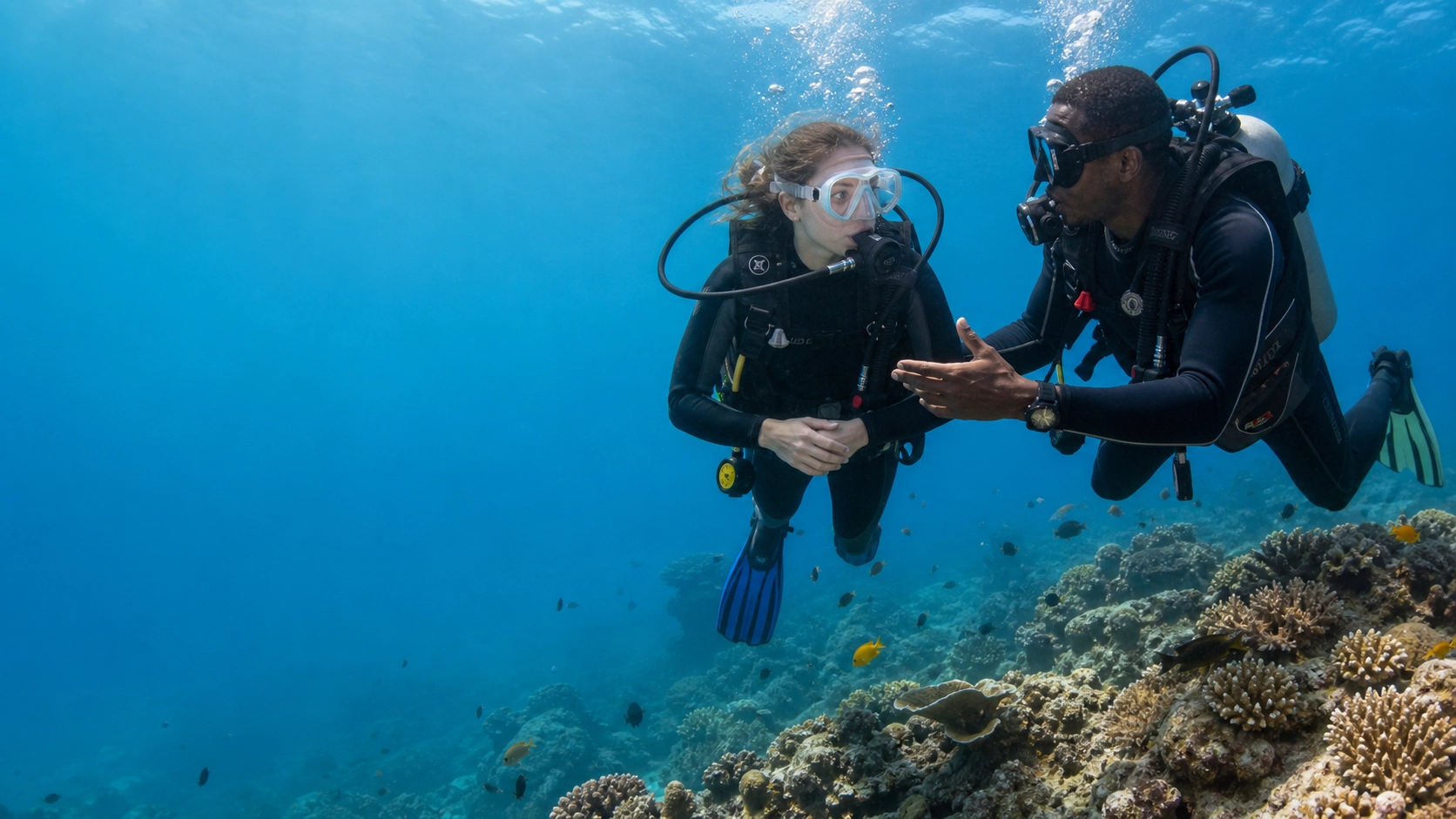
You will begin in a controlled environment, where your instructor will explain the equipment and help you become comfortable breathing underwater. Once you are ready, you can experience the ocean under close supervision.
A Basic Diver experience allows you to:
- Try scuba diving without committing to a full certification
- Learn how the essential equipment works
- Practise a few simple underwater skills
- Experience the coral reefs of Diani
- Decide whether you want to continue your training
This is the best choice if you are curious about scuba diving but not yet certain that you want to complete a full course.
If you already know that you want to become a certified diver, you can go directly to the SSI Open Water Diver course.
Choose SSI Scuba Diver if You Have Limited Time
The SSI Scuba Diver course sits between a beginner experience and the complete Open Water Diver certification.
At Ocean Tribe, this is a two-day programme designed for people who would like a recognised but limited certification. It allows you to dive to a maximum depth of 12 metres under the supervision of a dive professional.
It can be a good option if:
- You have limited time during your holiday
- You expect to dive with a guide
- You want more training than an introductory experience
- You are not yet ready to complete the full Open Water course
The limitation is that you will still need professional supervision when you dive. If you want the freedom to dive with another qualified buddy, the SSI Open Water Diver course is the better first qualification.
Make SSI Open Water Diver Your First Full Certification
For most new divers, the SSI Open Water Diver course at Ocean Tribe is the right place to begin.
This is your first complete scuba diving certification. Once qualified, you can dive with another certified diver in conditions similar to those in which you trained, within the limits of your certification and experience. The standard maximum depth for an adult SSI Open Water Diver is 18 metres.
The course has three main elements.
Digital Learning
You will study subjects including dive equipment, buoyancy, underwater pressure, breathing gases, safe ascent procedures and dive planning.
SSI provides the academic material digitally, allowing you to study at your own pace through the MySSI app. Your instructor will then help you apply that knowledge and clarify anything you do not fully understand.
Confined-Water Training
In the pool, you will practise the skills needed to dive safely and confidently. These include clearing your mask, recovering your regulator, sharing air, controlling your buoyancy and responding calmly to common problems.
The objective is not simply to perform each exercise once. You should become comfortable enough to repeat the skills without unnecessary stress.
Open-Water Training Dives
You will then take your skills into the ocean. Ocean Tribe’s location in Diani gives new divers access to sheltered training sites and coral reefs where they can gradually build confidence.
By the end of the course, you should be able to prepare your equipment, plan and conduct a dive with a buddy, monitor your air and depth, control your buoyancy and make a safe ascent.
Should I Take Open Water and Advanced Open Water Together?
Some divers want to continue directly from Open Water into the SSI Advanced Open Water Diver programme. This can work well when you have enough time, feel comfortable underwater and want to develop your skills through additional supervised dives.
The current SSI Advanced Open Water Diver programme consists of five open-water training dives. Deep Diving and Navigation form the core of the course, while the remaining three dives introduce you to other speciality areas.
Taking the courses together can give you a concentrated period of training and expose you to a wider range of diving. However, there is no need to rush.
If you are still concentrating on your mask, breathing, buoyancy or air consumption, spend some time making relaxed dives first. Additional experience will help you get more from advanced training.
Build Experience Between Scuba Diving Courses
A certification confirms that you have met the requirements of a course. Experience comes from applying those skills repeatedly in real conditions.
After becoming an Open Water Diver, make time for some enjoyable dives. Focus on:
- Maintaining neutral buoyancy
- Improving your position and trim
- Monitoring your air without being reminded
- Staying aware of your buddy
- Following the dive plan
- Making slow, controlled ascents
- Becoming familiar with your equipment
- Observing marine life without touching or disturbing it
There is no perfect number of dives that you must complete before continuing. Some people are ready for more training almost immediately, while others benefit from a longer period of practice. Your instructor can help you make an honest assessment.
Which SSI Speciality Courses Should I Take First?
After Open Water Diver, SSI allows you to choose courses based on your interests and the type of scuba diving you plan to do.
At Ocean Tribe, some of the most useful early specialities include the following.
Perfect Buoyancy
Good buoyancy makes almost every part of diving easier. It helps you conserve air, use less energy, avoid accidental contact with coral and become a more controlled underwater photographer.
The SSI Perfect Buoyancy course is one of the best choices for a recently certified diver. Ocean Tribe also offers an Open Water and Perfect Buoyancy combination for beginners who want additional skill development from the start.
Enriched Air Nitrox
Nitrox contains a higher percentage of oxygen than ordinary air and can provide longer no-decompression limits on suitable dives.
It is particularly useful during dive holidays when you may be making several dives over consecutive days. The course also helps you understand oxygen exposure, analysing a cylinder and setting an appropriate dive computer gas mixture.
Navigation
Navigation helps you become less dependent on following a guide. You will learn to use a compass, recognise natural references and maintain awareness of your position throughout a dive.
These skills can make you a more confident, capable and reliable buddy.
Deep Diving
The Deep Diving speciality prepares you to explore beyond the standard Open Water Diver depth limit. It covers gas planning, buoyancy changes, increased air consumption and the effects depth can have on a diver.
Deeper does not automatically mean better, but this training can open access to dive sites that are unavailable within the Open Water limit.
Night and Limited Visibility
A familiar reef can feel completely different after sunset. The Night and Limited Visibility course teaches communication, navigation, light handling and the procedures needed to dive safely when visibility is reduced.
Waves, Tides and Currents
Understanding water movement is extremely valuable when scuba diving in the ocean. This course helps you assess conditions, plan entries and exits and respond appropriately to currents.
Ocean Tribe offers a broad selection of SSI speciality courses in Diani, so your instructor can help you create a pathway suited to your goals.
Understand SSI Certifications and Recognition Levels
One of the strengths of the SSI system is that it recognises both training and experience.
After Open Water Diver, you can earn recognition levels by completing speciality programmes and logging your dives in MySSI:
- SSI Specialty Diver: two speciality programmes and 12 logged dives
- SSI Advanced Specialty Diver: four speciality programmes and 24 logged dives
- SSI Master Diver: Deep Diving, Diver Stress & Rescue, three additional speciality programmes and 50 logged dives
These recognition levels are different from the SSI Advanced Open Water Diver course. Advanced Open Water is a five-dive training programme, while Advanced Specialty Diver recognises the combination of four completed specialities and at least 24 logged dives.
That distinction can initially seem confusing, but the principle is sensible: SSI rewards both education and genuine experience.
Take Diver Stress and Rescue When You Are Comfortable
Once you are confident managing yourself underwater, the next major step is learning how to prevent and manage problems involving other divers.
The SSI Diver Stress and Rescue course teaches you to:
- Recognise stress before it develops into an emergency
- Assist a tired or panicked diver
- Search for a missing diver
- Respond to an unresponsive diver
- Manage emergency situations more effectively
- Become a more observant and dependable buddy
Many people describe rescue training as one of the most valuable scuba diving courses they complete. It changes the way you observe other divers and often increases your confidence both above and below the surface.
You should also complete suitable first-aid, CPR and oxygen-provider training. SSI’s React Right programme covers essential emergency skills and provides a natural companion to rescue training.
Choose the Instructor, Not Only the Training Agency
Ocean Tribe is an SSI training centre, and we believe the SSI system offers an excellent combination of digital learning, practical training, flexibility and experience-based recognition.
However, the training-agency logo is not the only thing that matters.
A certification is only as good as the training behind it. Two instructors following the same standards can create very different learning experiences. When choosing a dive centre, ask about:
- Instructor experience
- Student-to-instructor ratios
- The time available for skill practice
- Equipment quality and maintenance
- Training conditions
- Whether additional support is available if you need it
- What is included in the course price
- How the centre approaches safety and environmental responsibility
A good instructor will not rush you through a skill or make you feel uncomfortable for needing more practice. They will adapt the training to your needs while ensuring that you meet every required performance standard.
At Ocean Tribe, the objective is not merely to issue a certification card. It is to help you become a safe, capable and confident diver.
What Is the Best SSI Scuba Diving Course Order?
For most people, the ideal progression is:
- SSI Basic Diver, if you want to try scuba diving first
- SSI Scuba Diver, if you need a shorter, limited certification
- SSI Open Water Diver as your first complete qualification
- Fun dives to strengthen your core skills
- SSI Advanced Open Water Diver or selected speciality courses
- Perfect Buoyancy, Navigation, Nitrox and other relevant specialities
- SSI React Right
- SSI Diver Stress and Rescue
- Further specialities and experience towards Master Diver
- Dive Guide or Divemaster training if you want to become a professional
You do not have to complete every stage, and the route is not identical for every diver. Someone planning a week of tropical boat diving may choose different specialities from a diver preparing for cold water, strong currents or wreck exploration.
Start Your Scuba Diving Journey at Ocean Tribe
If you are completely new to scuba diving, begin with SSI Basic Diver or go directly to Open Water Diver. If you already hold an entry-level certification, your next course should address a real skill, interest or diving objective.
The most important thing is to build strong foundations. Take time to develop your buoyancy, awareness and confidence. Combine training with genuine diving experience, and choose instructors who care about the quality of your education.
At Ocean Tribe in Diani Beach, we can help you choose an SSI course pathway that matches your available time, current experience and future ambitions—whether you want to enjoy your first coral-reef dive, become an SSI Master Diver or begin a professional career beneath the surface.