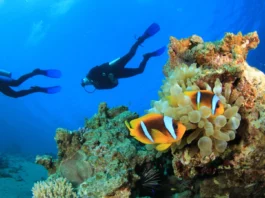
When daylight ends, the reef wakes up.
Learn to dive safely and confidently after dark. Master dive-light use, low-visibility navigation, night communication and controlled movement while discovering a completely different side of the ocean.

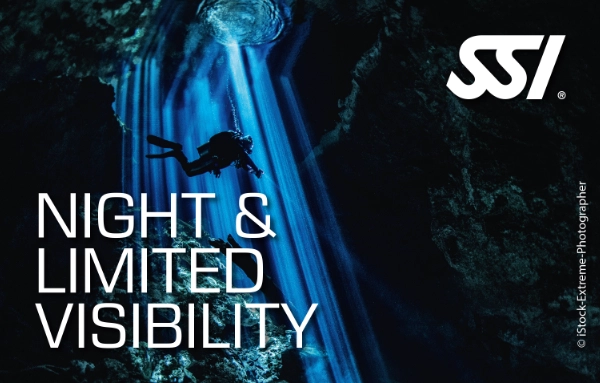
Discover a familiar ocean transformed by night.
Diving after sunset changes your perspective completely. Your torch restores vivid colour, nocturnal animals emerge and familiar reef formations take on an entirely new character.
The SSI Night & Limited Visibility course teaches you how to prepare for darkness, control your light, maintain buddy contact and navigate confidently when visual references are reduced.
- Use primary and backup dive lights correctly
- Communicate with hand and torch signals
- Maintain buddy contact in low-light conditions
- Navigate using a compass and natural references
What you’ll learn
Practical skills for night diving and any situation where visibility becomes reduced.
Dive-light techniques
Handle your torch effectively, avoid dazzling your buddy and use light to illuminate signals and points of interest.
Night communication
Combine normal hand signals with torch signals so that your buddy can understand you in darkness.
Low-visibility navigation
Use a compass, depth, time and natural references when distant visual landmarks are unavailable.
Controlled buoyancy
Maintain depth and position without relying on the wide visual references available during daylight.
Buddy awareness
Position yourself carefully, monitor your buddy’s light and avoid becoming separated.
Nocturnal behaviour
Observe how different species feed, rest, hide and interact once daylight disappears.
Your torch becomes part of the conversation.
At night, communication depends on more than ordinary hand signals. You need to illuminate your hands without shining directly into your buddy’s eyes and understand agreed movements of the light beam.
How the course works
Prepare online, review procedures before sunset and complete two instructor-led night dives.
SSI digital learning
Complete the Night & Limited Visibility theory and knowledge reviews in the MySSI app.
Equipment and safety briefing
Review dive-light use, backup lights, buddy procedures, communication, navigation and lost-buddy protocols.
Night dive one
Adapt to the darkness while practising light handling, buddy positioning, signals and controlled navigation.
Night dive two
Build confidence by applying your skills more independently while exploring the reef’s nocturnal marine life.
Certification
Meet the required knowledge and performance standards to earn your SSI Night & Limited Visibility Diver certification.
What’s included
Who can join?
Entry requirements
You must be at least 15 years old and hold an SSI Open Water Diver certification or an equivalent entry-level certification from another recognised training organisation.
Medical requirements
Participants must complete the required diver paperwork and meet the medical questionnaire requirements.
Certain conditions or medications may require medical clearance before participating in the dives.
Who comes out after dark?
Encounters vary by site and conditions, but night diving can reveal behaviours and animals you rarely notice during the day.
Octopus
Often more active while hunting across the reef at night.
Crabs and shrimp
Small crustaceans emerge from reef cracks and hiding places.
Lobsters
Frequently leave their daytime shelters once darkness arrives.
Sleeping reef fish
Observe how reef species rest, hide and change behaviour.


Add Night Diving to Advanced Open Water
The SSI Advanced Open Water Diver programme introduces you to five different specialty areas. Night & Limited Visibility may be available as one of your elective adventure dives, depending on conditions and course scheduling.
It is a flexible way to sample night diving alongside areas such as Deep Diving, Navigation, Perfect Buoyancy, Wreck Diving or Photo & Video.
*Final dive selection, depth and complimentary dive depend on age, scheduling, conditions and the selected course format.
Night Diving FAQs
Is night diving frightening?
Feeling nervous before a first night dive is normal. A detailed briefing, suitable site, reliable lights and close instructor supervision help the experience feel structured and manageable.
What happens if my dive light stops working?
Night-diving procedures include planning for light failure, remaining close to your buddy and carrying suitable backup lighting when required.
How do I communicate underwater at night?
Divers illuminate normal hand signals and use agreed torch movements. Your instructor will review these signals during the pre-dive briefing.
Where will the night dives take place?
Training takes place at a suitable reef or dive site selected according to conditions, logistics and the needs of the course.
Do I need excellent navigation skills first?
You do not need a separate Navigation certification, but basic compass awareness is useful. The course develops techniques specifically for darkness and limited visibility.
Can I bring an underwater camera?
Discuss this with your instructor. Your first priority is learning safe night-diving procedures, buoyancy and communication. A camera adds task loading and may not be appropriate during all training.
Does this course count towards SSI recognition levels?
Night & Limited Visibility is an SSI specialty certification and can contribute towards SSI recognition levels when combined with the required certifications and logged dives.
The ocean doesn’t sleep. Neither does adventure.
Contact Ocean Tribe to check the next suitable night-diving date and experience Diani’s reefs after sunset.