If you are planning to become a scuba diving instructor, you will probably encounter two main training routes: the PADI Instructor Development Course and the SSI Instructor Training Course.
Both can lead to a professional qualification that allows you to teach recreational scuba diving around the world. However, the courses differ in structure, pricing, teaching philosophy and how instructors operate after certification.
This PADI IDC vs SSI ITC comparison explains those differences without the usual agency rivalry. It also looks at the factor that matters most when starting a diving career: whether your training gives you enough practical experience to become a confident and employable instructor.
PADI IDC vs SSI ITC at a Glance
| Feature | PADI IDC | SSI ITC |
|---|---|---|
| Full name | Instructor Development Course | Instructor Training Course |
| Entry-level instructor rating | Open Water Scuba Instructor | Open Water Instructor |
| Main training components | Assistant Instructor course and OWSI programme | Assistant Instructor and Instructor Training Course |
| Final assessment | PADI Instructor Examination | SSI Instructor Evaluation |
| Minimum age | 18 | 18 |
| Minimum experience to begin | Normally 60 logged dives | 75 open-water dives totalling at least 50 hours under current SSI standards |
| Experience required for final qualification | 100 logged dives | 100 open-water dives totalling at least 65 hours |
| Typical format | DigitalIntensive classroom, confined-water and open-water programme | Digital learning, academic workshops, confined water, open water and teaching practice |
| Instructor affiliation | PADI instructors can potentially operate independently if all professional requirements are met | SSI instructors must affiliate with an active SSI Training Centre |
| Recognition | Extensive global dive-centre network and strong customer recognition | Large international network with a strongly centre-supported training model |
| Course price | Set by individual PADI centres, with some agency fees commonly charged separately | Set by individual SSI centres; packages may bundle training, materials and evaluation |
Exact requirements and fees can change. Always request an itemised quotation and confirm the latest standards with your chosen Instructor Training Centre.
What Is the PADI IDC?
The PADI Instructor Development Course, normally shortened to PADI IDC, is the professional programme used to prepare candidates to become PADI Open Water Scuba Instructors.
The IDC contains two main parts:
- The Assistant Instructor course
- The Open Water Scuba Instructor programme
Most candidates complete both sections together before attending a separate PADI Instructor Examination.
During the course, candidates learn how to:
- Apply PADI standards and procedures
- Deliver knowledge-development presentations
- Demonstrate and teach skills in confined water
- Conduct open-water teaching presentations
- Organise courses and supervise student divers
- Manage risk and respond to problems
- Use the PADI teaching system and course materials
A PADI Divemaster can normally begin an IDC after being a certified diver for at least six months. Candidates need at least 60 logged dives to enrol and 100 dives before attending the Instructor Examination.
Recent CPR and first-aid training, a current medical statement signed by a physician and an Emergency First Response Instructor rating are also required. The EFR Instructor course can usually be completed alongside the IDC.
What Is the SSI ITC?
The SSI Instructor Training Course, or SSI ITC, prepares Divemasters and equivalent dive professionals to become SSI Open Water Instructors.
SSI’s pathway can also be divided into stages. A candidate may complete the Assistant Instructor programme first and return for the remaining instructor training later, or complete the combined programme as one continuous course.
The ITC includes:
- SSI digital learning
- Dive theory and standards
- Academic teaching presentations
- Confined-water teaching
- Open-water teaching
- Skill demonstrations
- Rescue and problem-management exercises
- Dive guiding and briefings
- Course administration
- The business of diving
- Career planning
Current SSI standards recommend approximately 72–85 hours for the ITC. Candidates must then pass a separately conducted SSI Instructor Evaluation.
Under current SSI standards, candidates can begin with at least 75 logged open-water dives totalling 50 hours. They must have at least 100 open-water dives and 65 logged hours to complete the programme and proceed through the qualification process.
Candidates must also be at least 18, hold an active Divemaster or equivalent professional rating and have an Enriched Air Nitrox 40 certification or recognised equivalent. Individual Instructor Training Centres may apply additional entry requirements or require candidates to arrive with all 100 dives completed.
PADI IDC vs SSI ITC- How Do the Course Structures Compare?
The practical objectives of the two programmes are similar. Both teach candidates to turn their existing diving knowledge into safe, structured student training.
Both routes normally contain:
- Independent digital study
- Dive-theory revision
- Standards and course administration
- Classroom or academic presentations
- Confined-water teaching presentations
- Open-water teaching presentations
- Rescue skills
- Skill demonstrations
- A final independent assessment
The most noticeable difference is how the systems are organised.
PADI IDC Structure
PADI divides the IDC into the Assistant Instructor and Open Water Scuba Instructor sections. Candidates who complete the entire IDC attend an Instructor Examination conducted by PADI examination staff.
PADI IDCs are frequently delivered as intensive programmes lasting approximately 10 days to two weeks, although duration and preparation time vary between centres. Some centres add workshops, specialty instructor courses, equipment training or teaching internships.
SSI ITC Structure
SSI also provides a staged pathway through Assistant Instructor, ITC and Instructor Evaluation. The programmes can be completed separately or combined.
SSI places considerable emphasis on the relationship between the instructor and an affiliated SSI Training Centre. Course administration, quality management and student certification are connected to that centre relationship.
At Ocean Tribe, the main ITC programme is normally taught over approximately 10–11 training days, followed by the SSI Instructor Evaluation. An informal preparation period can also be included before the formal course.
The programme covers academic teaching, confined and open-water presentations, rescue skills, dive guiding, SSI administration, the business of diving and career planning.
PADI IE vs SSI IE
Neither completing the IDC nor completing the ITC automatically makes someone an instructor. Candidates must also pass the relevant final evaluation.
PADI Instructor Examination
The PADI Instructor Examination is conducted separately from the IDC. Candidates are assessed in areas that normally include:
- Dive theory
- PADI standards
- Knowledge-development teaching
- Confined-water teaching
- Skill Demonstrations
- Open-water teaching
- Rescue ability
The examination is designed to confirm that candidates can apply the PADI system safely and consistently.
SSI Instructor Evaluation
The SSI Instructor Evaluation is also separate from the ITC and is conducted by an authorised SSI Instructor Certifier rather than simply being signed off by the trainer who prepared the candidate.
It assesses areas including:
- SSI System knowledge
- SSI training standards
- Academic Teaching presentations
- Confined-water instruction
- Open-water instruction
- Skill demonstrations
- Rescue ability
An SSI Instructor Evaluation must normally be completed within six months of finishing the ITC. If more time passes, an Instructor Trainer may need to reassess the candidate’s readiness.
PADI IDC vs SSI ITC Cost
There is no single worldwide price for either instructor programme. Dive centres set their own training fees, while agency fees, materials, equipment, accommodation and optional instructor ratings can alter the final cost considerably.
A low advertised course price is therefore not always the lowest total price.
Common PADI IDC Costs
A PADI IDC quotation may contain separate charges for:
- IDC tuition
- PADI digital learning and instructor materials
- Instructor Examination fee
- Instructor application or processing fees
- Emergency First Response Instructor training
- Specialty Instructor applications
- Equipment rental
- Diving, tanks and boat fees
- Accommodation
- Medical examination
- Professional membership and insurance
Some PADI centres combine these expenses into one package. Others advertise the training fee and require candidates to pay materials and examination charges separately.
Common SSI ITC Costs
An SSI ITC quotation may contain:
- ITC tuition
- SSI digital learning
- Instructor materials or crew pack
- Instructor Evaluation fee
- Professional registration or crossover fees
- Specialty Instructor seminars
- Equipment rental
- Accommodation
- Diving before or after the course
- Professional renewal and insurance
At the time of writing, Ocean Tribe’s SSI ITC packages start from US$2,199. The entry package includes the informal preparation programme, ITC, digital materials, instructor crew pack and SSI Instructor Evaluation.
Ocean Tribe also offers packages that can include accommodation, a Divemaster Instructor Seminar and a complete set of professional dive equipment. Because prices and inclusions can change, candidates should confirm the current total before booking.
How to Compare Prices Properly
Before choosing a programme, ask each centre for a written breakdown covering:
- Training fees
- Digital materials
- Final evaluation
- Application fees
- Required first-aid instructor training
- Equipment rental
- Accommodation
- Professional registration
- Annual renewal
- Insurance
- Specialty Instructor ratings
- Any taxes or boat charges
Compare the final amount required to leave as an active instructor—not simply the headline course price.
Which Qualification Has Better Career Prospects?
Both PADI and SSI instructors work in major diving destinations. Neither certification guarantees employment, and most dive centres hire the person rather than the logo on the instructor card.
PADI has exceptionally strong consumer recognition and an extensive international network. In destinations dominated by PADI centres, holding a PADI instructor rating can provide access to a larger number of immediately compatible vacancies.
SSI also has a substantial international network, which has been growing very fast in the past few years especially in destinations where price is a huge factor for consumers. Its centre-based model can work particularly well for instructors who want to become part of an established training team with integrated administration, teaching materials and quality management.
An important operational difference is that SSI professionals must affiliate with an active SSI Training Centre to teach and certify SSI students. PADI instructors may have more scope to operate independently, provided they maintain teaching status and meet local legal, insurance and operational requirements.
In practice, your best first qualification may depend on where you hope to work. Search vacancies in your preferred destinations and see which agencies local employers use.
What Dive Centres Look for Beyond the Instructor Card
A newly qualified instructor with exactly 100 dives may meet agency standards but still have limited professional experience.
Employers commonly look for instructors who can:
- Communicate clearly with nervous beginners
- Demonstrate excellent buoyancy and control
- Conduct organised dive briefings
- Assist on boats and manage equipment
- Recognise developing problems early
- Provide good customer service
- Sell courses and continuing education appropriately
- Work calmly as part of a team
- Teach in more than one language
- Take photographs or create social-media content
- Maintain equipment or fill cylinders
- Hold useful specialty ratings
- Legally work in the destination concerned
This is why the quality of the training centre and the amount of practical experience can matter more than choosing PADI or SSI purely by name.
Check out the Dive Business Manager Dive Centre Operations & Management Professional course to really kick off your career prospects
Can You Change from PADI to SSI Later or Vice Versa?
Yes. Qualified dive professionals can change from PADI to SSI—or from SSI to PADI—by completing the receiving agency’s crossover requirements.
You do not normally need to repeat your entire instructor course, but you may need to complete digital learning, attend an orientation or crossover programme, demonstrate your teaching knowledge and pay the relevant application fees.
Exact requirements depend on your current professional rating, teaching status and experience. Many instructors maintain active credentials with both agencies, although this means paying separate annual professional renewal fees.
Both PADI and SSI require you to attend part of the Instructor training program and the Instructor Exam/Evaluation.
How Much Does It Cost Each Year to Be a PADI or SSI Instructor?
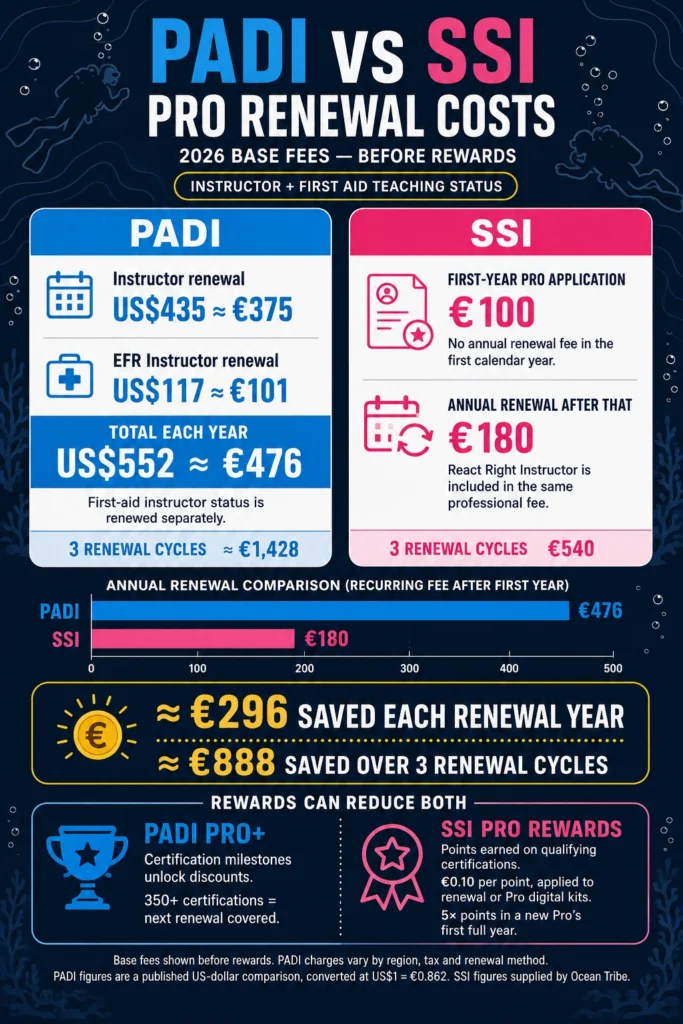
Annual professional fees vary by region and payment method, but a PADI Instructor can expect to pay approximately US$435 (€375) for instructor membership, plus about US$117 (€101) annually to maintain a separate EFR Instructor rating. This brings the combined yearly cost to approximately US$552 (€476), before any PADI PRO+ rewards or discounts. An SSI Instructor pays a €100 professional application fee in the first year and currently pays approximately €180 per year thereafter. SSI’s single professional fee includes the React Right Instructor rating, and SSI Pro Rewards can reduce the renewal cost further. Based on these figures, maintaining SSI Instructor status can save approximately €296 per renewal year.
Compare the PADI and SSI Pro Reward Schemes

Which Course Should You Choose?
Choose a PADI IDC if:
- Most dive centres in your preferred destination use PADI
- You value PADI’s strong consumer brand recognition
- You may want the option of working more independently
- You have found an excellent PADI Course Director and training centre
- A potential employer specifically requests a PADI rating
Choose an SSI ITC if:
- You plan to work with an SSI Training Centre
- You prefer a centre-supported professional system
- You value SSI’s digital learning and administration
- The available ITC includes useful practical experience
- Your preferred instructor trainer or internship operates through SSI
Most importantly, choose the trainer and centre that will prepare you for real students—not simply the programme promising the fastest certification.
How to Enrol on the SSI ITC at Ocean Tribe
Follow these six steps from your first enquiry to the Instructor Evaluation in Diani Beach, Kenya.
You are already a Divemaster or hold an equivalent professional certification from another recognised training agency.
-
Contact Ocean Tribe
Share your current certification level and number of logged dives.
-
Outline Your Experience
Provide details of your diving experience and previous training agency.
-
Complete the Checks
Ocean Tribe will verify your professional status and current documentation.
Certifications Logged dives CPR and first aid Dive medical -
Choose Your ITC Package
Select the training, accommodation and equipment options you need.
-
Prepare Online
Complete the SSI digital learning and any preparation work before the formal course begins.
-
Travel to Diani
Join the preparation programme, formal Instructor Training Course and Instructor Evaluation.
Preparation programme → Instructor Training Course → Instructor Evaluation
Candidates can view the current course calendar or contact Ocean Tribe through WhatsApp. A deposit is normally required to secure a place, with the remaining balance due before arrival.
Start from Any Level with an Ocean Tribe Dive Career Internship
You do not need to be a Divemaster before contacting Ocean Tribe.
The Ocean Tribe dive career internship packages provide structured pathways for:
- Complete beginners
- Open Water Divers
- Advanced divers
- Rescue divers
- Divemasters ready for instructor training
Depending on your starting level, an instructor internship can include recreational courses, Enriched Air Nitrox, navigation, deep and night diving, React Right first aid, Diver Stress & Rescue, Dive Guide, Divemaster, Science of Diving, the SSI ITC and the Instructor Evaluation.
The programmes combine formal certification with regular diving and experience inside a working dive centre. Interns can practise briefings, assist instructors, prepare equipment, work with customers and develop professional habits before becoming responsible for their own students.
Selected packages include unlimited diving during the internship, SSI materials and fees, professional mentoring and a complete set of new scuba equipment to keep. Accommodation, ecology programmes, extra Specialty Instructor seminars and a Kenyan wildlife safari can also be added.
This route takes longer than arriving only for an instructor course, but it can produce a more experienced and employable new professional.
Final Verdict: PADI IDC or SSI ITC?
There is no universal winner in the PADI IDC vs SSI ITC comparison.
PADI offers powerful brand recognition, a broad international network and greater potential flexibility for instructors who may eventually want to operate independently.
SSI offers an internationally recognised qualification built around a close relationship between instructors and training centres. Its digital system, flexible staged pathway and centre-supported model appeal to many working dive professionals.
Your career prospects will ultimately depend on the quality of your training, your attitude, your practical experience and the needs of employers in the destinations where you want to work.
If you already meet the professional prerequisites, you can enrol directly on the SSI ITC at Ocean Tribe in Diani Beach. If you are not there yet, Ocean Tribe can build a dive career internship around your current level and guide you from beginner, certified diver or Divemaster through to SSI Open Water Instructor.
The right course earns you an instructor card. The right training prepares you to use it.