Few topics get more myths, jokes and nervous questions in the dive community than gas narcosis. You may have heard it called “the martinis” or “rapture of the deep”, and it sounds slightly romantic. In reality, it’s a real physiological effect that every scuba diver should understand before heading below 18 metres.
At Ocean Tribe in Diani Beach, we cover it in training because the best way to deal with narcosis is to know what it is, recognise it early and plan your dives around it.
What Is Gas Narcosis?
Gas narcosis is a reversible state of altered thinking and coordination caused by breathing certain gases under pressure. When you dive on air, nitrogen is the gas most people blame, which is why you’ll often hear the term nitrogen narcosis. But nitrogen isn’t the only gas involved, as you’ll see below.
On the surface, the gases in the air you breathe have no noticeable effect. As you descend, the pressure rises, and so does the partial pressure of those gases. Past a certain point, this starts to affect your nervous system. The result feels like mild intoxication.
Scientists don’t fully agree on the exact mechanism, but the effect is well documented, and it’s directly linked to depth.
Nitrogen Narcosis and Oxygen Narcosis
Nitrogen narcosis gets most of the attention, but oxygen is also narcotic under pressure. Studies suggest it is at least as narcotic as nitrogen. So when you breathe air or nitrox at depth, you’re dealing with both nitrogen narcosis and oxygen narcosis at the same time. That’s why instructors prefer the broader term.
This has a few practical consequences:
- Nitrox doesn’t solve it. Enriched air has less nitrogen but more oxygen, so the overall effect stays much the same. Nitrox is chosen to extend your no-decompression time, not to make a deep dive feel clearer.
- Helium is the exception. It isn’t narcotic at recreational and technical depths, so technical divers replace some of the nitrogen and oxygen with helium to keep their heads clear on very deep dives.
Oxygen narcosis is not oxygen toxicity. The two are often confused:
| Narcosis (nitrogen and oxygen) | Oxygen toxicity | |
|---|---|---|
| Cause | Breathing narcotic gases under pressure | A high partial pressure of oxygen |
| Effect | Impaired judgement, euphoria, slowed reactions | Can cause convulsions, which are especially dangerous underwater |
| Relevance | Increases with depth on any gas mix | Mainly a concern with nitrox and deeper dives, so divers stay within safe oxygen limits |
| Fix | Ascend a few metres and symptoms fade | Ascend and stop breathing the high-oxygen gas, and seek medical attention |
Narcosis is a gradual, reversible effect. Oxygen toxicity is a more serious risk with a strict limit. That’s why nitrox divers are trained to check their gas mix, set a maximum operating depth and never dive deeper than it.
How Deep Does Narcosis Start?
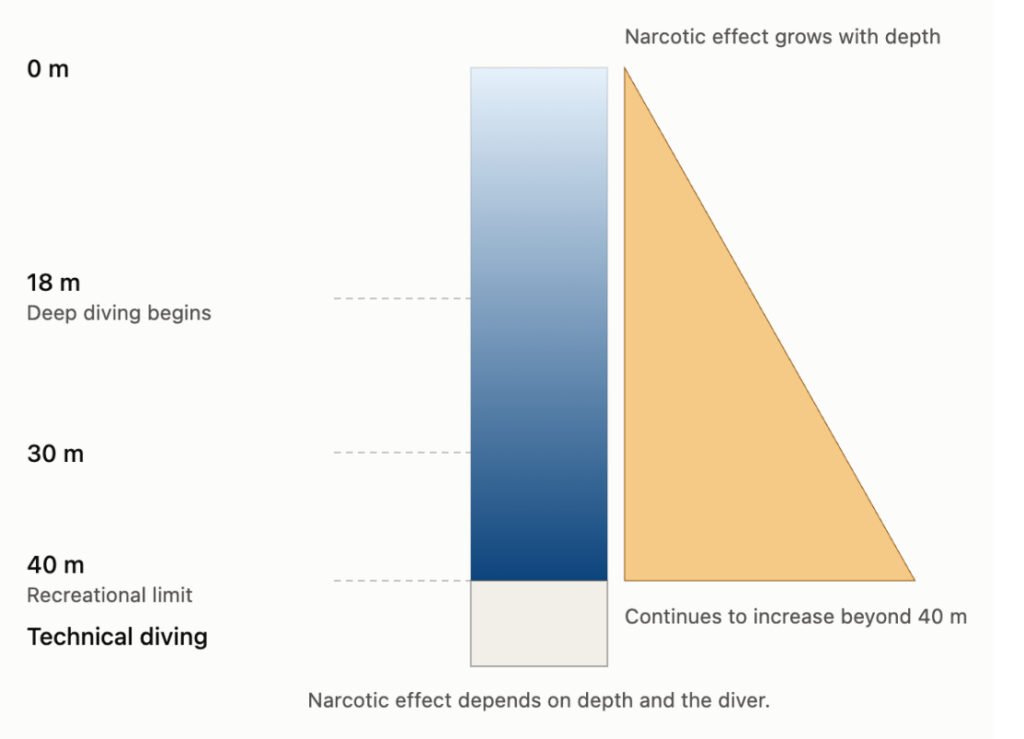
There’s no single depth where it switches on. It builds gradually as you go deeper, and it varies from diver to diver and even from dive to dive.
- Shallower than 18 metres: rarely noticeable for most divers.
- Around 18 to 30 metres: subtle effects can begin. Many divers notice nothing, but some feel slightly “off”.
- 30 metres and beyond: the effects become more common and more pronounced. Judgement, concentration and coordination can all be affected.
This is one reason depth limits exist in recreational diving. An SSI Open Water Diver is certified to 18 metres, an SSI Advanced Open Water Diver to 30 metres, and the SSI Deep Diving Specialty prepares you for dives down to the 40 metre recreational limit.
What Does It Feel Like?
Symptoms are often subtle at first, and that’s what makes narcosis tricky. An affected diver may not realise anything is wrong. Signs can include:
- Feeling light-headed, relaxed or unusually euphoric
- Difficulty concentrating or making decisions
- Slowed reaction times and poor coordination
- Fixating on one thing and ignoring gauges, your buddy or the dive plan
- Anxiety or unexplained unease
- Impaired memory of what happened on the dive
- In severe cases, confusion and loss of awareness
The danger isn’t the feeling itself. It’s that impaired judgement can lead to poor decisions, such as ignoring your air supply, going deeper than planned or missing a problem with your buddy.
What Makes It Worse?
Several factors can increase the chance and severity of narcosis:
- Depth. The most important factor by far.
- Cold water. Being cold can add to the effect.
- Poor visibility or low light. Dark, murky conditions can make you feel more disoriented.
- Anxiety or stress. Nervous divers tend to be more affected.
- Fatigue. Diving tired reduces your mental reserves.
- Alcohol and medication. Never dive with a hangover or after drinking. Be cautious with any medication that causes drowsiness.
- Heavy exertion and CO2 build-up. Working hard or breathing too shallowly can make symptoms stronger.
How to Manage Gas Narcosis
The good news is that it’s entirely reversible, and there’s a simple cure: ascend a few metres. As the pressure drops, the symptoms fade quickly with no lasting effect.
The key is to stay ahead of it:
- Plan your depth and dive within your training. Don’t exceed your certification level.
- Build up gradually. Experience helps you recognise how your own body reacts as you go deeper.
- Stay with your buddy and check on each other. It’s often easier to spot narcosis in someone else than in yourself.
- Monitor your gauges regularly. Make checking air and depth a habit.
- Stay calm and breathe slowly. Avoid overexertion at depth.
- If something feels off, ascend. Signal your buddy and move to shallower water until you feel normal.
- Never dive when tired, unwell or after alcohol.
Common Myths
“You can train yourself to be immune.” Not really. Experience helps you recognise and cope with the effects, but nobody becomes immune. Even very experienced divers can be affected.
“Nitrox prevents it.” No. Nitrox reduces nitrogen narcosis but adds oxygen narcosis, so the overall effect is much the same. Nitrox is useful for extending bottom time, not for avoiding narcosis.
“It only happens to nervous or inexperienced divers.” It can affect anyone, at any experience level.
“It’s the same as decompression sickness.” It isn’t. Narcosis is a short-term effect of breathing gas under pressure, and it clears when you ascend. Decompression sickness is caused by nitrogen bubbles forming in the body after a dive and is a separate and serious condition.
Narcosis and Deeper Diving
It’s a big part of why technical divers going beyond 40 metres use different breathing gases. Replacing some of the nitrogen and oxygen with helium reduces the effect at depth. That’s an advanced skill set and requires specific training, such as the SSI Extended Range path.
For recreational divers, the answer is simpler: respect your limits, plan carefully and learn how your body reacts.
Learn More with Ocean Tribe
Understanding gas narcosis is one of the best reasons to take the SSI Deep Diving Specialty. You’ll learn how to plan, how to recognise the signs and how to stay in control when you go deeper.
Ocean Tribe is a registered SSI Diamond Instructor Training Centre at The 41 Beach Club on Diani Beach. Our small dive groups and experienced instructors make it easy to build your skills with confidence. Book your dive online and enjoy a $10 online discount, or get in touch to find the right course for you.
Frequently Asked Questions
What is gas narcosis?
It’s a reversible change in thinking and coordination caused by breathing gases such as nitrogen and oxygen under pressure at depth. It feels similar to mild intoxication.
What is the difference between nitrogen narcosis and oxygen narcosis?
They’re the same effect caused by different gases. Both nitrogen and oxygen are narcotic under pressure, and on air or nitrox you experience both together.
How deep do you have to go to feel it?
It varies from person to person, but it’s rarely noticeable above 18 metres and becomes more common from about 30 metres.
Is it dangerous?
The effect itself is temporary, but it can impair your judgement and lead to unsafe decisions. That’s why recognising it and ascending at the first sign is so important.
How do you get rid of it?
Ascend to shallower water. Symptoms typically fade quickly as the pressure drops.
Is oxygen narcosis the same as oxygen toxicity?
No. Oxygen narcosis impairs judgement and clears when you ascend. Oxygen toxicity is a separate risk linked to a high partial pressure of oxygen and can cause convulsions, so nitrox divers must stay within their maximum operating depth.
Does nitrox stop narcosis?
No. Nitrox lowers the nitrogen but raises the oxygen, and both are narcotic under pressure.
Can experienced divers get it?
Yes. Experience helps you recognise it, but it can affect any diver.