Learning how to use less air when scuba diving is one of the biggest steps you can take to improve your diving. It means longer dives, less stress, and a much more enjoyable experience underwater. The good news is that air consumption is not about luck or lung size. It is about technique, control and relaxation.
In this guide, we break down exactly how to improve it.
Understand Why You Use Air
Before fixing it, you need to understand it. Air consumption is affected by several factors. Depth plays a major role. The deeper you go, the more air each breath uses. Your fitness level, body size and even water temperature also matter.
However, the biggest factors for most divers are simple. Stress, poor buoyancy and inefficient movement. Fix those, and your air consumption improves quickly.
Master Your Breathing
Breathing is the number one place to start. Most divers think smaller breaths save air. They do not. Shallow breathing is inefficient and leads to a faster breathing rate.
Instead, focus on slow, deep breathing.
Take a long inhale. Fill your lungs fully. Then take an even longer, controlled exhale. This removes carbon dioxide properly and delays the urge to breathe again. Over time, your breathing becomes slower and more efficient. Keep it continuous and relaxed. Never hold your breath. Just settle into a steady rhythm.
Relax More Than You Think
If you only take one thing from this article, take this. Relax.
Stress is the biggest air killer in scuba diving. When you are tense, your heart rate increases and your breathing speeds up. That burns through your tank fast. New divers often use a lot of air simply because everything feels new. The solution is experience. The more you dive, the more comfortable you become.
Before every dive, slow down. Take a few deep breaths. Visualise the dive. Once underwater, stop rushing. Nothing is chasing you.
Perfect Your Buoyancy
Good buoyancy changes everything.
If you are not neutrally buoyant, you are constantly working. Kicking to stay up. Fighting to stay down. Adding and dumping air from your BC. All of that uses energy. And energy uses air.
When your buoyancy is dialled in, you hover effortlessly. You: move less, breathe less and enjoy more. This is why courses like Perfect Buoyancy and just diving and practicing are some of the best investments a diver can make.
Get Your Weight Right
As part of getting your buoyancy right you need to consider your weighting. Overweighting is one of the most common problems in diving.
Too much lead means you have to inflate your BC more. That creates drag. Drag makes you work harder. Working harder means more air used.
Do a proper buoyancy check. You should float at eye level with an empty BC and sink slowly when you exhale. Getting this right instantly improves air consumption.
But remember. You need to consider what tank you are diving. Aluminium tanks get more buoyancy as the air is removed from them. So you should make sure your buoyancy check is done with an almost empty aluminium cylinder to account for your buoyancy at the end of the dive.
Slow Everything Down
Speed is the enemy of efficiency underwater. Water is dense. Moving faster requires a lot more energy. Even doubling your speed can massively increase how much air you use.
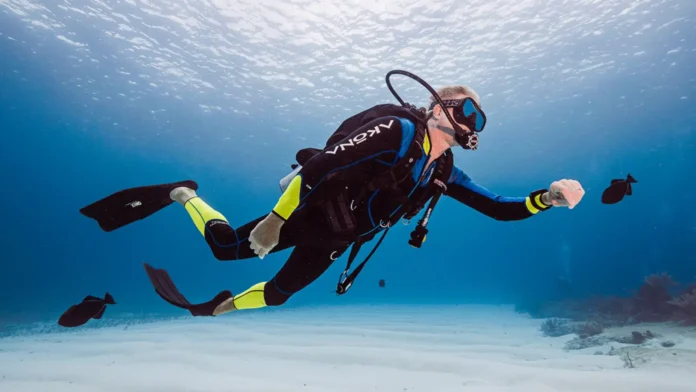
Instead, move slowly and deliberately. Glide between fin kicks. Think smooth, not fast. Watch experienced divers. They look almost lazy underwater. That is exactly what you want.
Improve Your Trim and Streamlining
Your position in the water matters. If your body is angled up, your fins create drag. If hoses and gauges are dangling, they slow you down. Aim to be flat and horizontal. Keep everything tucked in close to your body. Streamlined divers move effortlessly and use far less air.
Use Efficient Finning Techniques
Many divers kick from the knees like they are riding a bicycle. It is inefficient and tiring. Instead, kick from the hips. Use longer, smoother movements. Techniques like the frog kick allow you to glide and conserve energy. Less effort equals less air used.
Dive Shallower When You Can
Depth has a direct impact on air consumption. For example at 30 metres, you will use air much faster than at 10 metres. The pressure is 4 bar as opposed to 1 bar at the surface. So you will use air 4 times as quickly. That is simple physics.
So if you are swimming over sand or moving between sites, stay shallower where possible. Save the deeper sections for when there is something worth seeing.
Stay Warm
Cold divers breathe more. It is that simple. Your body burns energy to stay warm. That increases your breathing rate. Wear the right exposure suit. If you get cold easily, go thicker. A comfortable diver is always a more efficient diver.
Stay Fit, Hydrated and Rested
Your body plays a big role. Good cardiovascular fitness improves how efficiently you use oxygen. Hydration helps your body function properly. Being well rested keeps your stress levels down. On the other hand, fatigue, dehydration and alcohol all increase air consumption.
Look after yourself. It makes a difference underwater.
Check Your Equipment
Small issues can waste a surprising amount of air. Leaking O-rings, a slightly free-flowing regulator or a poorly fitting mask all add up. Even constant mask clearing increases breathing rate. Make sure your gear is well maintained and serviced regularly. A good regulator that breathes easily can also make a noticeable difference.
Final Thoughts
Learning to use less air when scuba diving is not about competing with other divers. It is about becoming more efficient, more relaxed and more in control.
Focus on your breathing. Improve your buoyancy. Slow everything down. Dive more.
Do that, and you will notice a big change. More time underwater. More enjoyment. And a completely different diving experience.
Are there any other things I can do to improve my air consumption?
Apart from all of the advice above (and really this is the most important part). Other courses you can take to improve your air consumption and use less air include perfect buoyancy to assist your movement and comfort underwater. Funnily enough a great way to improve air consumption is by taking a freediving course where you can learn about minimising your movements and thus using less air when diving (it’s not about the breath-hold obviously).