If you’ve decided to learn to scuba dive, you’ve almost certainly stumbled across the same question every new diver lands on: what is the difference between PADI Open Water and SSI Open Water? Both are entry-level scuba certifications. Both let you dive to 18 metres with a buddy, anywhere in the world. Both are taught by professionals trained to international safety standards. So why does it even matter which one you pick?
At Ocean Tribe, we get asked this almost daily by guests planning their first dive trip to Kenya. The honest answer is that the difference between PADI Open Water and SSI Open Water is smaller than most people think — but the gap is in exactly the places that affect how you learn, how much you pay, and how comfortable you feel underwater. This guide walks through every meaningful difference so you can show up on the boat at Diani knowing exactly what you’re signing up for.
PADI vs SSI: A Quick Introduction
Before we get into the difference between PADI Open Water and SSI Open Water, a quick word on the two agencies themselves.
PADI (Professional Association of Diving Instructors) was founded in 1966 in the United States and is the largest and most heavily marketed dive training organisation on the planet. Most travellers have heard of PADI before they’ve heard of any other agency, and many people walk into a dive centre asking to “do their PADI” without realising other options exist.
SSI (Scuba Schools International) was founded in 1970 and is the world’s largest store-based training agency. SSI instructors must teach through an authorised SSI dive centre, which means the centre and the instructor share responsibility for the quality and safety of your training.
Both agencies are full members of the World Recreational Scuba Training Council (WRSTC), the international body that sets minimum standards for recreational dive training. That’s the critical bit: PADI and SSI follow the same safety standards, teach the same core skills, and produce the same kind of certified diver at the end of the course.
Are PADI and SSI Open Water Certifications Equally Recognised?
This is usually the first worry: “If I do an SSI Open Water in Kenya, will I be able to dive in Thailand, Egypt, the Caribbean or the Maldives next year?”
Yes. Unambiguously, yes.
A PADI Open Water Diver card and an SSI Open Water Diver card carry the same global recognition. Any reputable dive centre worldwide accepts both certifications, and you can switch agencies as you progress. You might do Open Water with SSI, Advanced with PADI, a specialty with NAUI, and Rescue Diver with SSI. You won’t need to repeat the same course at the same level.
So when people compare the difference between PADI Open Water and SSI Open Water, in terms of where the card is accepted. There is no difference. Both are honoured worldwide.
Course Structure: Where the Real Difference Begins
Both courses cover the same essential content. Dive theory, equipment skills, confined-water training (in a pool or shallow protected water), and four open-water training dives. What changes between the two is how those skills are taught.
PADI’s teaching model is rigid. Instructors must teach skills in a fixed sequence laid out by the agency. If a student is struggling with a particular skill — say, mask-clearing or regulator recovery — the instructor cannot legally move on to other skills first and come back later. The student has to keep trying until they nail the skill in front of the rest of the class, or the course pauses. Deviating from the prescribed order is a standards violation for the instructor.
SSI’s teaching model is flexible. SSI uses an 80/20 framework: 80% of the course is fixed content set by the agency, but 20% can be adapted by the instructor to suit the student. If you’re struggling with one skill, your SSI instructor can move you on to a couple of easier skills, build your confidence, then return to the tricky one later when you’re relaxed. Instructors can also add extra information or drills if it improves the quality of the diver.
For most beginners, this flexibility is the single most important practical difference between PADI Open Water and SSI Open Water. It tends to result in less stressed students, lower drop-off rates, and divers who finish the course feeling genuinely competent rather than just relieved it’s over. It’s a big part of why Ocean Tribe runs SSI as our primary agency — Diani’s warm, calm reef conditions are perfect for a paced, confidence-first approach.
Theory and Learning Materials: Paper, Apps and eLearning
Both agencies have moved most of their theory online, but the experience is different.
PADI’s eLearning is paid. You pay for access to the online course, and you typically retain that access for a limited window. You can access this via the PADI app or online in a browser. If you prefer paper, PADI sells physical manuals that you’re expected to keep for post-course review. Either way, the materials are an extra cost on top of the course fee.
SSI’s digital learning is delivered through the MySSI app (iOS, Android, or browser) and is paid overall. The first four Open Water sections are free, so you can preview the course before committing. The full course costs less than PADI’s equivalent.
Once unlocked, your materials stay in your MySSI library for life—useful for refreshers anytime. Your certification card, dive log, specialty cards, and dive centre locator are all in one app.
PADI splits its digital ecosystem across two apps: the main PADI app and PADI Adventures. Even inside those, you often get bounced out to browser pages to finish tasks. It works, but it’s clunky. MySSI keeps everything in one app — theory, certifications, logbook, dive centre locator and dive site info — no redirects.
So on materials and digital experience, SSI tends to come out ahead — both on cost and on usability.
Cost: Is One Cheaper Than the Other?
Course prices vary widely by region, but as a general rule SSI Open Water courses are slightly cheaper than PADI Open Water courses, mostly because:
- SSI digital learning is significantly cheaper than PADI’s eLearning (and the first four sections of the Open Water are free to preview).
- SSI’s agency fees for dive centres and instructors are lower, so those savings pass through to students.
The price gap on the certification itself isn’t huge (often the equivalent of an extra fun dive plus a couple of post-dive beers), but when you factor in materials, it adds up. For backpackers and budget travellers diving in Diani, that difference is usually meaningful.
Skill Development in the Water
In confined water and on your four open-water dives, the skills you’ll perform are essentially identical: mask clearing, regulator recovery, buoyancy control, controlled emergency swimming ascents, buddy checks, and so on.
What changes is the feel of the training. Under PADI, the prescribed order means every student in the group works through the same skill at the same time, and you must master it before progressing. Under SSI, your instructor can group, re-order or revisit skills based on your comfort level, often spending more time on the things you find harder and breezing through the things that come naturally.
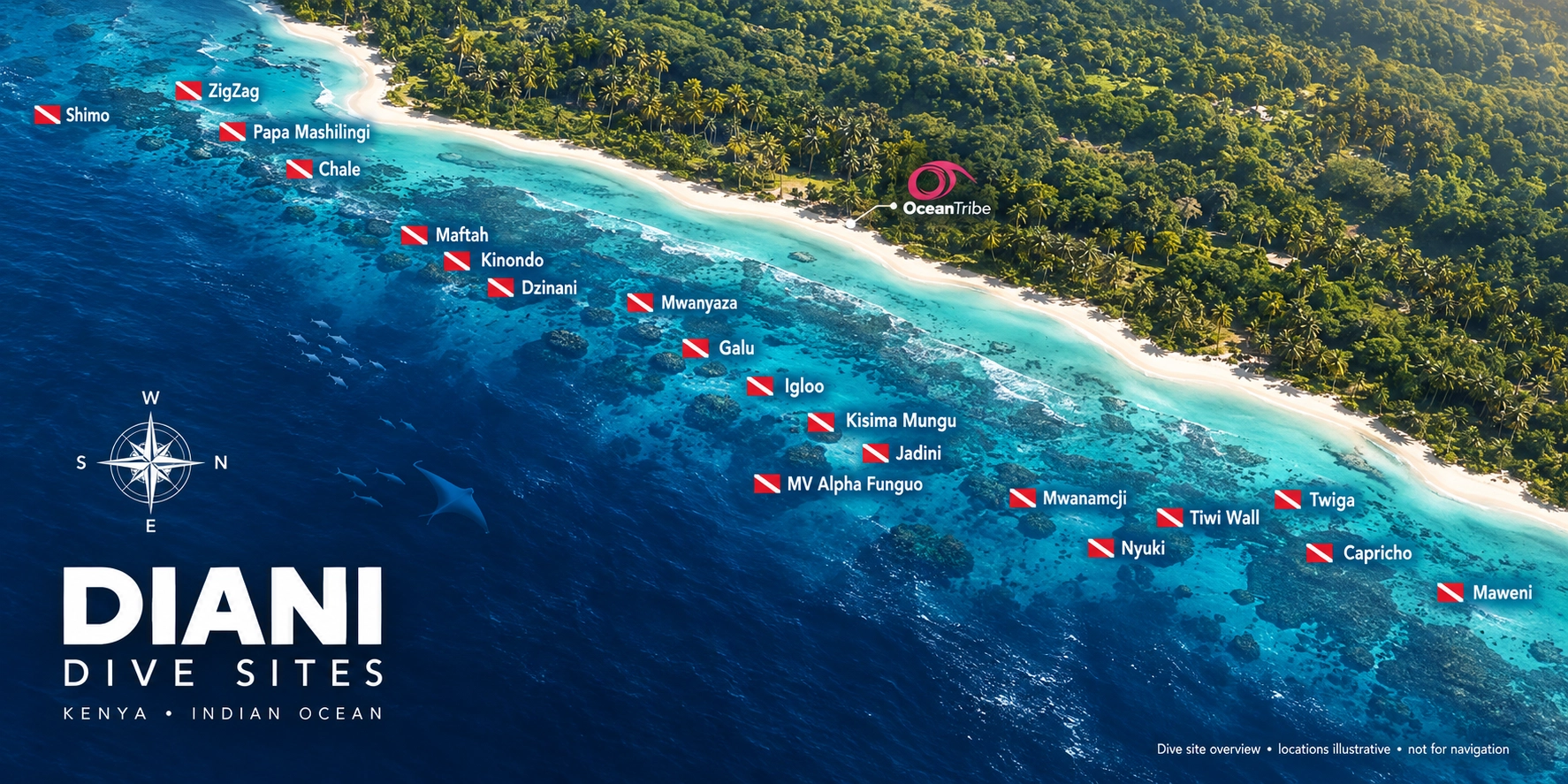
Many divers report feeling more relaxed underwater earlier in the course with SSI, simply because the structure is built around the student rather than the syllabus. That early confidence pays off when you start logging fun dives at Diani sites like Galu, Kinondo, Tiwi Wall or the MV Alpha Funguo wreck — places where calm, controlled buoyancy makes the difference between a good dive and a great one.
Certification Cards and Diver Recognition
Both agencies issue digital cards instantly on completion of your course, and both let you pay extra for a physical plastic card if you want one.
Where SSI pulls ahead is in diver recognition. SSI’s Diver Levels of Recognition system automatically promotes you up the ranks (Open Water Diver, Specialty Diver, Advanced Open Water Diver, Master Diver, and so on) as you log dives and complete specialties — at no extra charge. The card refreshes inside the MySSI app, which is a nice morale boost as your logbook fills up.
PADI charges a separate fee for higher recognition ratings like PADI Master Scuba Diver. The diving you’ve done is the same; the badge just costs more.
Going Pro: Why It Matters Down the Line
If your dream is to eventually become a Divemaster or Instructor — maybe even kick off a career change in Diani — the agency you pick at Open Water level isn’t locked in, but it does shape your pathway.
SSI Pro Rewards is a points-based programme where every course an SSI instructor teaches earns Pro Rewards points, which can offset annual renewal fees. For active, working instructors, it’s realistic to cover your annual renewal entirely through teaching, which is why so many career divers prefer SSI long-term.
PADI Pro+ Rewards is PADI’s more recent answer to the same idea — instructors earn rewards for certifications issued, which can be put towards renewal fees and other PADI services. It’s a welcome addition, but the structure, earn rates and overall value still tend to fall short of what SSI offers. We dug into the head-to-head in detail in SSI Pro Rewards vs PADI Pro+ Rewards: Has PADI Finally Caught Up? — short answer, not quite.
Quick Comparison Table: The Difference Between PADI Open Water and SSI Open Water
| Feature | PADI Open Water | SSI Open Water |
|---|---|---|
| Global recognition | Yes | Yes |
| Depth limit | 18 m | 18 m |
| Theory delivery | PADI App/Browser paid eLearning or paper manual | MySSI app/Browser — first 4 sections free, full course paid (cheaper than PADI) |
| Skill order | Fixed sequence | Flexible 80/20 model |
| Typical price | Slightly higher | Slightly lower |
| Physical card | Paid Optional/ Instant Digital | Paid Optional/ Instant Digital |
| Single unified app | No (2 apps) | Yes (MySSI) |
| Diver recognition levels* | Paid upgrades | Free, merit-based |
| Pro renewal* | PADI Pro+ Rewards- Significantly higher base renewal rate | Pro Rewards offsets fee |
| Instructor affiliation* | Can teach independently | Must teach through a centre |
*- These are not directly related to the Open Water Diver course but apply to descriptions of the differences between the two agencies as a whole.
So Which Should You Choose at Ocean Tribe?
Here’s the honest take. The difference between PADI Open Water and SSI Open Water at the recreational level is small enough that you’ll be a safe, confident, internationally recognised diver either way. The bigger choice — and the one we’d genuinely encourage you to focus on — is your dive centre and your instructor.
At Ocean Tribe, we’ve chosen SSI as our primary training agency because it matches how we like to teach: small group sizes, flexible pacing, and no embarrassment moments for nervous beginners. Plus a clean digital experience for students who’d rather not lug a paper manual through East Africa. Diani Beach is one of the easiest places in the world to learn to dive. It boasts warm water, gentle reefs, friendly turtles. SSI’s student-focused model lets us make the most of that.
You’ll come out of an SSI Open Water Diver Course with:
- A globally recognised digital certification in the MySSI app
- Lifetime access to your purchased course materials in the MySSI app for future refreshers
- All four open-water training dives on Diani’s reefs and wrecks
- A diver recognition card that grows with you as you log more dives
- The option to continue straight into Advanced Open Water, specialties, or pro-level training with the same team
If you’ve already done a PADI Open Water elsewhere and want to continue with us in Diani — no problem. We can pick you up at any level, and crossing between agencies for further training is seamless. The card in your wallet doesn’t change how welcome you are on our boat.
Frequently Asked Questions
Is SSI Open Water accepted at PADI dive centres worldwide?
Yes. Both PADI and SSI are members of the WRSTC and both certifications are accepted at any reputable dive centre globally.
Can I switch from SSI to PADI (or vice versa) after my Open Water?
Yes. You can do your Open Water with one agency and your Advanced, Rescue or specialties with another. No course needs to be repeated.
Is the PADI Open Water harder than the SSI Open Water?
No. The skills, theory and performance requirements are essentially identical because both agencies follow WRSTC minimum standards. SSI’s flexible teaching order tends to make the course feel easier for students who get stressed. But the certification level at the end is the same.
Which is cheaper, PADI or SSI?
SSI is usually slightly cheaper. The digital learning is paid for on both sides. SSI’s is meaningfully less expensive than PADI’s eLearning. Plus SSI lets you preview the first four sections of the Open Water course for free before you commit.
Does Ocean Tribe teach PADI or SSI?
Ocean Tribe is an SSI dive centre. We’ve chosen SSI because the flexible teaching model, free digital materials and student-focused approach produce more confident divers in our experience. If you must must must have PADI then we do have some PADI Instructors on staff but the cost of the course is slightly higher.
Ready to Get Certified in Diani?
The difference between PADI Open Water and SSI Open Water comes down to flexibility, cost, digital experience and long-term recognition — not the quality of the diving you’ll end up doing. Both will make you a certified diver. One of them is primarily taught here in Diani Beach by the Ocean Tribe team, on warm reefs full of turtles, reef sharks and the occasional whale shark.
If you’re ready to start, take a look at our SSI Open Water Diver Course, browse our Diani dive sites, or get in touch and we’ll help you plan your first proper dive trip to Kenya.
See you underwater.