“Should I use a camera during scuba training?”
It is one of the most common questions we hear. The world we live in today encourages us to capture and report everything we do.
You have signed up for a scuba diving course. You are excited. You are about to see a completely new world. You want to show your experience on Instagram, TikTok, Facebook, YouTube or simply share it with your friends on your phone.
We understand that. You do not want to miss the moment.
This is not helped by so-called influencers filming themselves acting irresponsibly underwater just to generate likes, clicks and shares. That content creates the impression that diving is about performance rather than skill.
GoPros, Insta360, DJI, even your phone in a housing such as Divevolk. There are many ways to capture your dive and the equipment looks simple to use.
But it is not just about pressing a button and pointing a lens.
If you are asking yourself, should I use a camera during scuba training, the honest answer is no.
Why Not?
You Are There to Learn How to Dive
Your Open Water Diver course or Try Scuba session is about building solid foundations. You must master buoyancy, trim, breathing control, finning technique and equipment awareness before adding distractions. Using a camera divides your attention at the exact moment when you need focus the most. It slows your learning and reduces the quality of skill development when those early habits are being formed.
You Stop Paying Full Attention to Your Instructor
During training, your instructor demonstrates skills, gives corrections and closely monitors your progress. If you are thinking about angles and framing, you are not fully listening. You may miss a signal, a safety reminder or a depth instruction. Scuba training demands awareness and responsiveness. A camera competes directly with that focus.
Your Frame of Reference Shrinks
When you hold a camera, your world becomes the small screen in front of you. Instead of observing your surroundings, your buddy and your instructor, you concentrate on a narrow field of view. You stop seeing the bigger picture. New divers already find underwater awareness challenging. Adding a camera makes that challenge greater and can reduce situational awareness at a critical stage of your development.
Increased Breathing and Finning
Excitement naturally increases breathing rate. Adding task loading through filming increases it further. Many new divers begin finning harder to hold position while recording. That leads to instability, faster air consumption and unnecessary movement. Training dives are about learning calm, efficient control. Cameras often create the opposite effect.
Distraction From Air Gauges and Dive Computers
During training, you are learning to regularly monitor your air pressure, depth and no decompression limits. These checks must become automatic habits. If your attention shifts to filming, you will check your gauges less often. That is not a pattern you want to establish early in your diving life. Strong monitoring routines are built from the very first dives.
Buoyancy Problems and Reef Damage
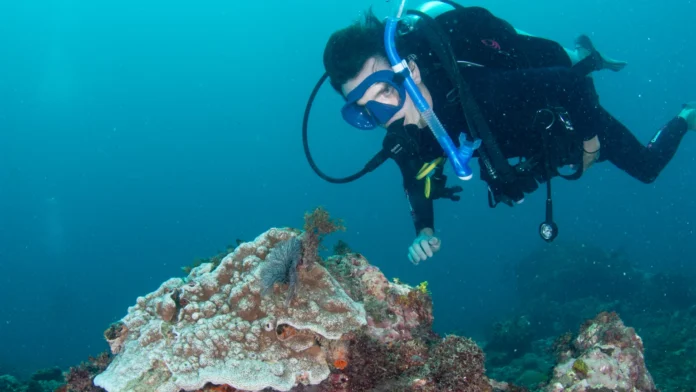
One of the biggest concerns is buoyancy. When you focus on filming, buoyancy often suffers. You drift up or down without realising it. You may damage coral, disturb marine life or interfere with other divers. Perfect buoyancy takes time and repetition to develop. Training dives are where that control should be refined, not compromised.
You Lose the Use of Your Hands
During scuba training, your hands are important tools. You use them to adjust your inflator, operate dump valves, clear your mask and manage your regulator. If both hands hold a camera, you rely entirely on your fins to control position. That is difficult for new divers who are still developing finning technique and balance underwater.
Solutions
Do not treat your Open Water course or Try Scuba session as a bucket list activity. Scuba diving is a skill for life. You will have many more dives to capture the underwater world. Focus now on learning properly and experiencing it fully rather than watching it through a screen.
That being said, we do not want to ruin the fun completely. If you would like memories of your first dives, we can arrange for a photographer to accompany you and capture the moment safely. You can also ask a qualified diver who is not on the course to swim nearby and take photos or video for you.
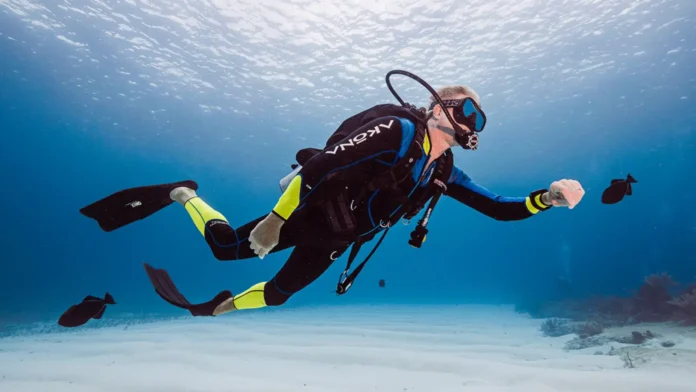
Once you are certified, you can pursue further training before regularly using a camera underwater. Courses such as SSI Perfect Buoyancy and Photo and Video specialties help you develop the control required to film responsibly. Even after qualification, keep diving as your priority. Gain experience first. Practise camera handling in environments where you cannot damage anything, such as a swimming pool or over a sandy bottom.
Final Answer
So, should I use a camera during scuba training? No. That’s the straight answer. Learn to dive first. Master buoyancy. Build awareness. Develop safe habits. The ocean will still be there. And when you are ready, you will be able to capture it properly.