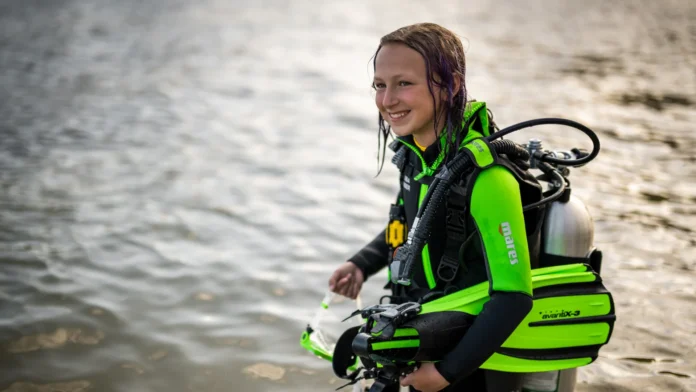
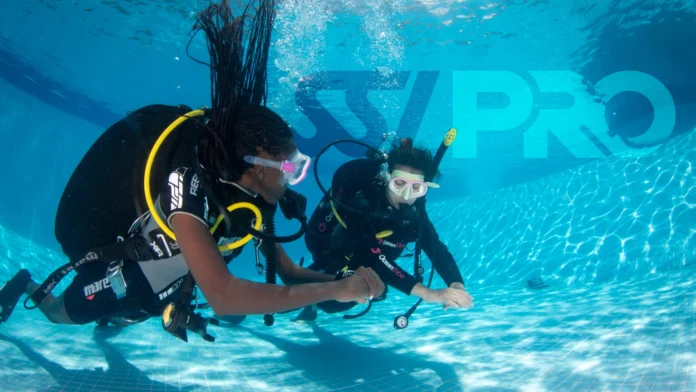
WELCOME TO THE OCEAN TRIBE ONLINE DIVE THEORY LEARNING CENTRE
This is your go-to hub for understanding scuba theory. We’ve gathered clear explanations, expert tips, and top videos from across the diving world. Everything is designed to help you learn faster and smarter.
Browse each category to explore detailed topics. Watch helpful videos. Review key concepts. Reinforce your dive knowledge.
Whether you’re just starting or preparing for your SSI Instructor Training Course, this is the place to build confidence and clarity.
Your path to becoming a dive professional starts here. Let’s dive in.
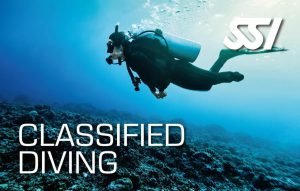
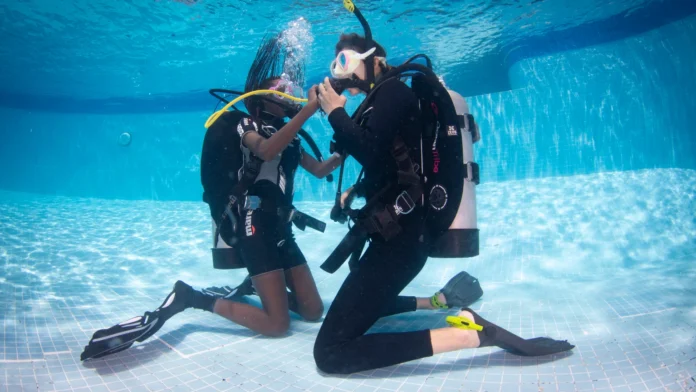
The SSI Classified Diving program has been created to enable persons with disabilities who might not be able to earn full certifications the ability to dive and get certified with different safety parameters. Learn to work with disabled divers.
Ready to become a diving instructor and turn your passion into a paycheck? This July, you can do exactly that on the white-sand shores of Diani, Kenya. That feeling you get after every dive — the one where you never want it to end — is where every great diving career begins. So let’s help you build one.
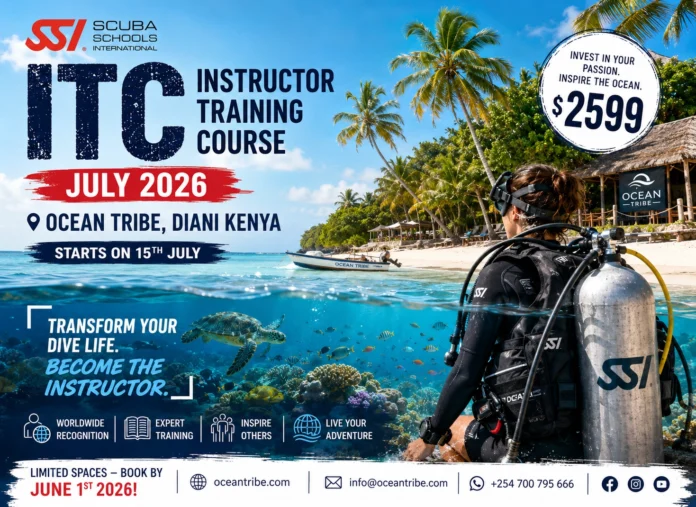
Ocean Tribe is running its next SSI Instructor Training Course (ITC) starting 15th July 2026. Honestly, it might be the best decision you make all year.
Why Become a Diving Instructor at Ocean Tribe?
Diani Beach consistently ranks among the world’s most beautiful beaches. Furthermore, Ocean Tribe sits right at the heart of it. Warm Indian Ocean water, vibrant coral reefs and a tight-knit community of dive pros make this a rewarding place to train. So when you choose to become a diving instructor here, you get more than a certification. Indeed, you step into a lifestyle, a network and a career that travels the world.
SSI (Scuba Schools International) is one of the largest and most respected diver training agencies globally. Moreover, SSI instructor ratings are recognised in every major dive destination, from the Red Sea to the Coral Triangle. As a result, the qualification you earn in Diani opens doors everywhere.
What the July ITC Includes
The full Ocean Tribe ITC package is built around one goal. You arrive as a confident Divemaster. Then you leave as a polished, employable, multi-rated SSI Instructor. Here is what you get for $2,599:
Internship preparation in the weeks before the ITC — dive Diani, assist on courses, practice teaching skills and close any knowledge gaps
SSI Instructor Training Course with full digital learning materials
SSI Instructor Evaluation (IE) — your final certifying exam
Accommodation at Stilts Treehouses for the duration of your training
Four additional Specialty Instructor ratings: React Right (Emergency First Response), Classified Diving (adaptive diving for divers with disabilities), Deep Diving, plus Navigation Diving
Ocean Tribe T-shirt, Neutral Buoyancy Teaching Workshop, Video Analysis and Feedback Sessions, Introduction to Sidemount Diving, DiversDesk Management System Workshop, plus full CV preparation and job-seeking assistance
By the end of the course, you will be qualified to teach a huge range of SSI programs. For example, these include Try Scuba, Open Water Diver, Advanced Open Water and Perfect Buoyancy. Also on the list: Enriched Air Nitrox, Diver Stress & Rescue, Science of Diving and Divemaster. Finally, you can teach Marine Ecology, SSI Explorers and the four specialties above. Clearly, that is a serious teaching toolkit to walk away with.
UNLIMITED DIVING AFTER THE ITC – Dive Club Membership
Prefer a Lighter Package? You Have Options
Not everyone needs the full all-inclusive experience, and we get that. For example, you might already have accommodation sorted. Alternatively, you may want to add specialty ratings later. In that case, we offer a stripped-back ITC package from $2,199. This option covers your ITC, your Instructor Evaluation and all required materials. However, it skips the extra specialty instructor courses and accommodation.
Either way, you finish the same way: as a certified, job-ready SSI Open Water Instructor.
Where You Will Stay
Full-package students stay at Stilts Backpackers. The lodge is a wooden treehouse property tucked into the forest canopy. Plus, it sits just behind Ocean Tribe at the 41 Beach Club. Beds come in single, double, twin or triple configurations. In addition, mosquito nets, bedding and towels are provided free of charge. The communal toilet and shower block is well maintained. However, if you want more privacy, private single rooms are also available. Imagine falling asleep to the sound of the forest. Then you wake up a five-minute walk from the dive centre. Honestly, it is a pretty special way to spend an instructor course.
Optional Extras to Make It Your Own
Want to push your training even further? Then you can add any of these:
Instructor Essential Equipment Package — $1,249 (X Deep Zeos BC, Mares Puck Lite dive computer, Mares Dual ADJ 15X regulator, full-length 3mm wetsuit, mask, snorkel, DSMB and reel, Avanti Superchannel fins, plus MC970 knife)
Instructor Elite Equipment Package — $1,549 (Cressi Aquawing BC or Mares XR Rec Trim BC, Mares Sirius dive computer, plus Mares Dual ADJ62X regulator)
Extra Specialty Instructor Ratings — $90 each
2-Night / 3-Day African Safari at Ngutuni Lodge — $250
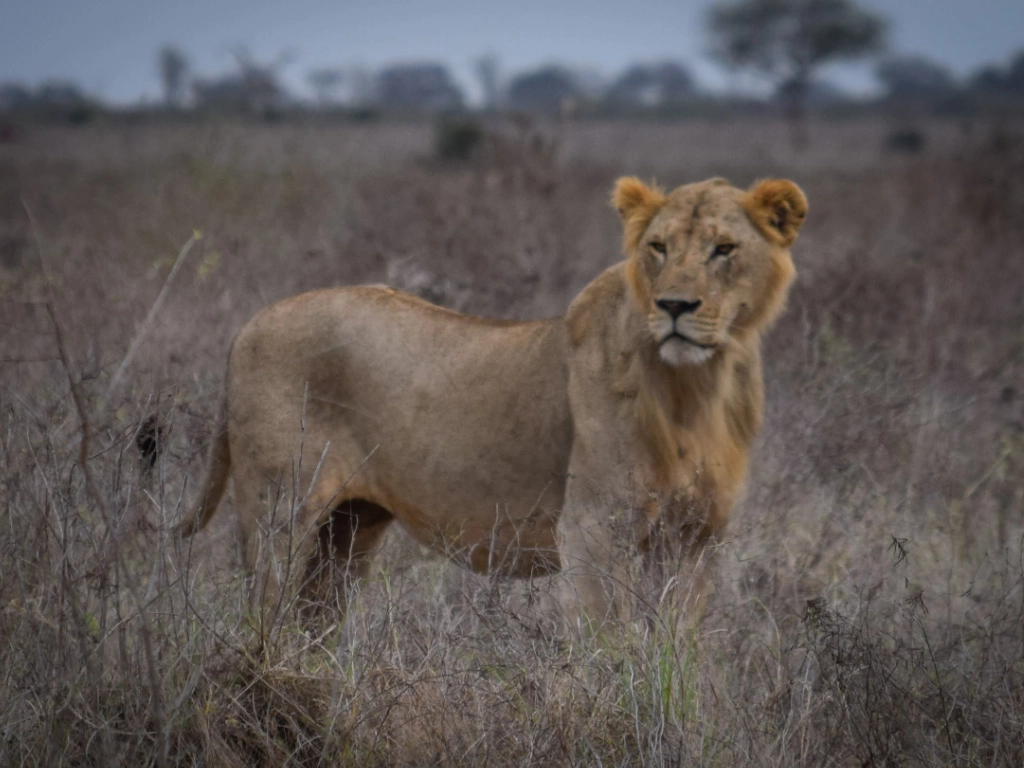
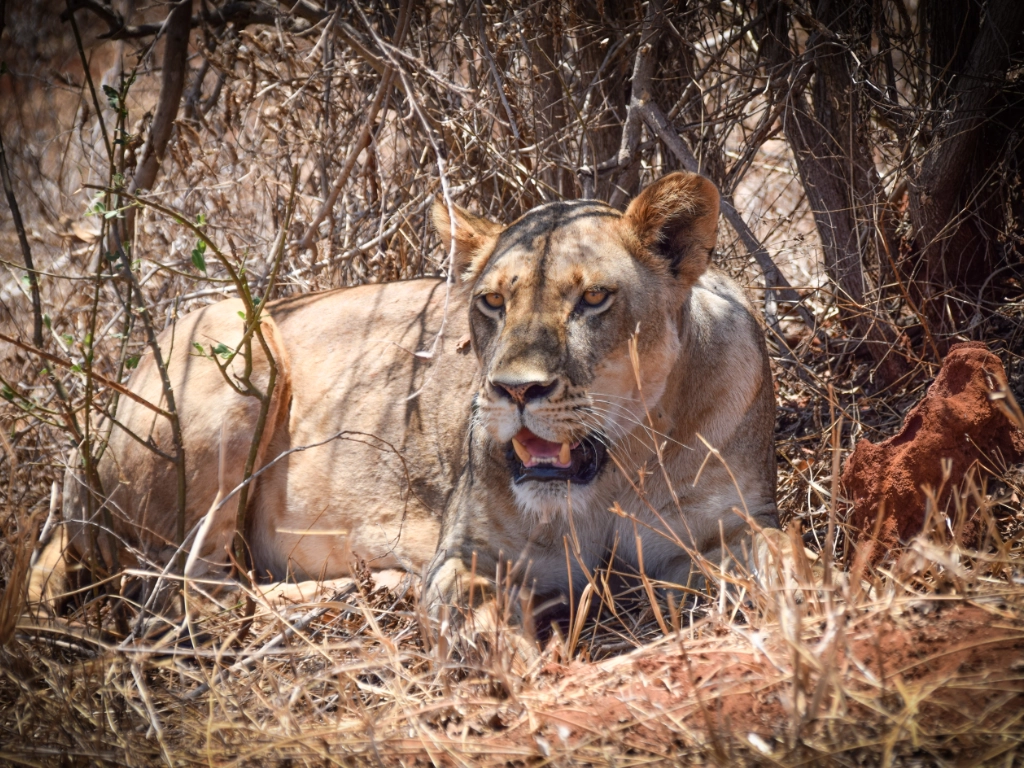
Because, honestly, if you are flying all the way to Kenya, you might as well see the lions too.
Book by 1st June and Get a Free Gift
Lock in your spot before 1st June 2026 and you can choose one of the following on the house:
A free 3-Day / 2-Night African Safari, or
A Mares Puck Lite Dive Computer to take into your new career
Both gifts are genuinely useful. One feeds your soul. The other lives on your wrist.
Is This Course Right for You?
First, you should be a certified Divemaster, or close to it. Next, you need to be in good health. Finally, you should be ready to commit a few intense weeks to your career. If that sounds like you, then yes — this course is for you.
Of course, the ITC is demanding. There is academic work, teaching presentations, in-water skill demonstrations and a final Instructor Evaluation. However, our pre-course internship and small group sizes mean you will be well prepared. Furthermore, our instructor trainers have decades of combined experience. Indeed, they have a proven track record of turning nervous Divemasters into confident, hireable instructors.
In short, to become a diving instructor is to join a global community. These are people who get to call the ocean their office. Maybe you want to teach in the Maldives next winter. Alternatively, you might run liveaboards in Indonesia. Perhaps you would rather manage a dive centre back home. Or you simply want to travel the world with a skill that pays. Either way, this is the qualification that gets you there.
Ready to Become a Diving Instructor in July?
Spots on the July ITC are limited. Meanwhile, the early-bird booking deadline of 1st June is creeping up fast. So if you have been waiting for a sign to finally become a diving instructor, this is your moment.
Adaptive diving is one of the most rewarding areas of scuba diving, yet it is still misunderstood by many divers and dive professionals. Questions about safety, training, accessibility, equipment adaptations, and what is actually possible underwater are common — especially from instructors considering working with divers with disabilities for the first time.
In this new video, Ocean Tribe Instructor Trainer Mark answers many of the most common questions about adaptive diving, inclusive diver training, and his own journey back into the underwater world after the accident that left him paralysed from the waist down.
Diving Changed — But It Didn’t End
One of the biggest misconceptions about disability and scuba diving is that an injury automatically means the end of adventure, exploration, or professional involvement in diving. In reality, adaptive scuba diving has opened the underwater world to people with a huge range of physical disabilities.
For Mark, returning to diving after paralysis was not simply about getting back underwater. It was about rebuilding confidence, adapting techniques, learning new approaches, and discovering that many of the perceived barriers to diving were actually logistical or educational rather than impossible obstacles.
Today, Mark works as an SSI Instructor Trainer and teaches both recreational and professional-level scuba diving, including the SSI Classified Diving programs designed specifically for divers with disabilities.
What Is Adaptive Diving?
Adaptive diving refers to the modification of scuba training, techniques, procedures, or equipment to safely support divers with physical, sensory, or other disabilities.
Every diver is different. Some adaptive divers may require very small modifications, while others may need significant assistance from their dive team or specialised teaching approaches. The goal is not to lower standards or ignore safety — it is to find safe and effective ways for people to experience scuba diving within their abilities.
Adaptive diving may involve:
Modified entries and exits
Alternative finning techniques
Buoyancy adaptations
Team-based diving approaches
Equipment customisation
Additional surface support
Adjusted teaching methods
Enhanced dive planning and communication
In many cases, divers with disabilities can become extremely capable and independent underwater divers.
Questions Covered in the Video
In this video, Mark discusses topics including:
How he returned to diving after paralysis
What adaptive diving actually looks like in practice
Common misconceptions about disabled divers
What instructors need to know before getting involved
How dive centres can become more inclusive
The realities of boat diving with a disability
Safety considerations in adaptive diving
Training pathways for dive professionals
Funny and challenging moments from his diving career since the accident
The video is intended both for divers with disabilities and for dive professionals interested in making diving more accessible.
Why More Dive Professionals Should Consider Adaptive Diving
Many instructors are nervous about teaching divers with disabilities simply because they lack experience or exposure. However, adaptive diving often becomes one of the most rewarding forms of instruction an instructor can undertake.
Teaching adaptive divers develops:
Better communication skills
More creative problem solving
Greater patience and empathy
Improved understanding of diving techniques
Stronger team diving practices
It also allows dive centres to welcome a wider community into the sport and create truly inclusive diving environments.
SSI Classified Diving Programs at Ocean Tribe
Ocean Tribe in Diani Beach, Kenya offers:
SSI Classified Diving Programs
SSI Classified Diving Instructor Seminars
Adaptive scuba experiences
Professional training for dive leaders and instructors
Support for divers with physical disabilities
Instructor seminars can also be conducted at other dive centres for teams interested in introducing adaptive diving programs.
Useful Resources
Divers With Disabilities Handbook https://oceantribe.co/uploads/Ocean-Tribe-Divers-With-Disabilities-Handbook-V.1_compressed.pdf
Learn More About the SSI Classified Diver Program https://oceantribe.co/scuba-diving-courses/classified-diving-centre/empowering-disabled-divers-understanding-the-ssi-classified-diver-program/
What Instructors Learn From Teaching Divers With Disabilities https://oceantribe.co/news-offers/what-instructors-learn-from-teaching-divers-with-disabilities/
FAQs
Can paraplegics go scuba diving?
Yes. Many paraplegic divers safely participate in scuba diving around the world. Training, support requirements, and adaptations vary depending on the individual diver.
Is adaptive diving safe?
Adaptive diving follows structured risk management and training procedures. Like all scuba diving, safety depends on proper training, planning, supervision, and appropriate diving conditions.
Do dive instructors need special training to work with disabled divers?
Formal adaptive diving training is highly recommended. Programs such as the SSI Classified Diving Instructor Seminar help instructors understand safe teaching methods, diver assessment, and adaptive techniques.
Can disabled divers become dive professionals?
In some cases, yes. Many divers with disabilities continue into leadership or instructional roles depending on their abilities, experience, and agency standards.
Does adaptive diving require special equipment?
Not always. Some divers use standard scuba equipment, while others may benefit from modified harnesses, propulsion methods, weighting systems, or entry and exit assistance.
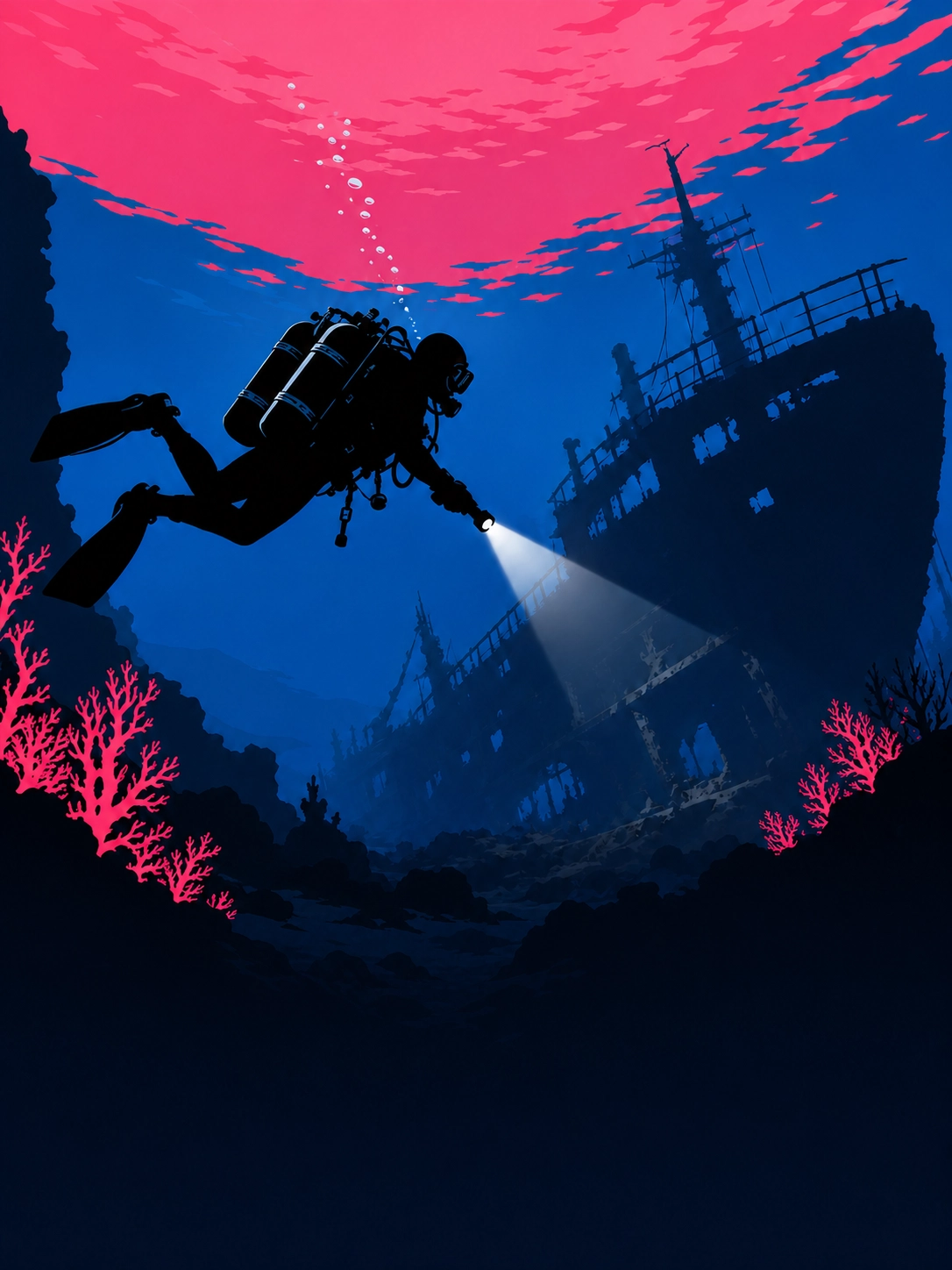
Few dives capture the imagination quite like dropping down a mooring line, watching the silhouette of a sunken ship slowly take shape beneath you, and finally crossing the threshold into a space the ocean has reclaimed. For divers who already love exploring wrecks but want to learn basic wreck penetration properly — with the training, equipment, and judgement to safely move beyond the exterior — this month’s featured specialty is the one to take: the SSI Advanced Wreck Diving Course.
What the SSI Advanced Wreck Diver Course Is
The SSI Advanced Wreck Diving program is designed to give certified divers the skills and knowledge to independently plan and conduct limited-penetration, no-decompression dives on wrecks within the daylight zone. According to the SSI standard, penetrations are limited to a maximum depth of 30 metres and a linear penetration distance of 40 metres, always within line-of-sight of natural light. It is a recreational overhead-environment course — the ideal place to learn basic wreck penetration before progressing to technical programs such as TDI Advanced Wreck or Extended Range Wreck Diving — and it bridges the gap between casual wreck exterior diving and full technical penetration training.
It is also a course best suited to divers who are already comfortable in the water. The prerequisites at Ocean Tribe are Deep Diving or Advanced Open Water certification, a minimum age of 15, and 20 logged dives. Maximum training depth is 40 metres.
What You Will Learn: Basic Wreck Penetration Skills, Step by Step
The course is genuinely skill-rich. Across two days, four open-water training dives, and a structured digital learning module, students learn basic wreck penetration techniques and the habits that make overhead-environment diving safe and repeatable. Areas of training include:
Gas management for wreck dives, including turn-pressure rules and reserve planning for overhead environments.
Wreck research and site selection, so divers can evaluate a wreck’s condition, history, hazards, and suitable entry points before stepping off the boat.
Specialised equipment for wreck diving — primary and backup dive lights, reels and line, slates, diver’s tools, mesh bags, and the configuration of a streamlined rig that does not snag on collapsed structures.
Mapping a wreck to build an accurate mental model of the site.
Reel and line technique, including laying a static guideline, managing slack, choosing solid tie-off points, and the critical “lost line” drill.
Light use and light-signal communication between team members — the universal OK, Attention, and Emergency beams that replace hand signals when visibility drops.
Streamlining, trim, and propulsion to avoid silting out compartments or damaging fragile structures.
Briefing and planning an overhead-environment dive: objective, duties, time, depth, route, gas limits, equipment, no-decompression limits, and emergency scenarios for lost line, lost diver, and low-on-gas situations.
DSMB deployment from within an overhead environment.
The four training dives progress logically: a wreck orientation dive, an exploration dive that introduces safety lines and a swim-through, an exterior line-laying dive, and finally an interior line-laying dive — the culmination of the course.
Where the Training Is Conducted
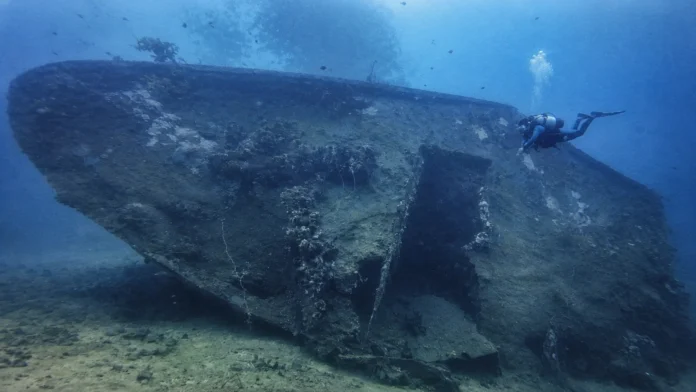
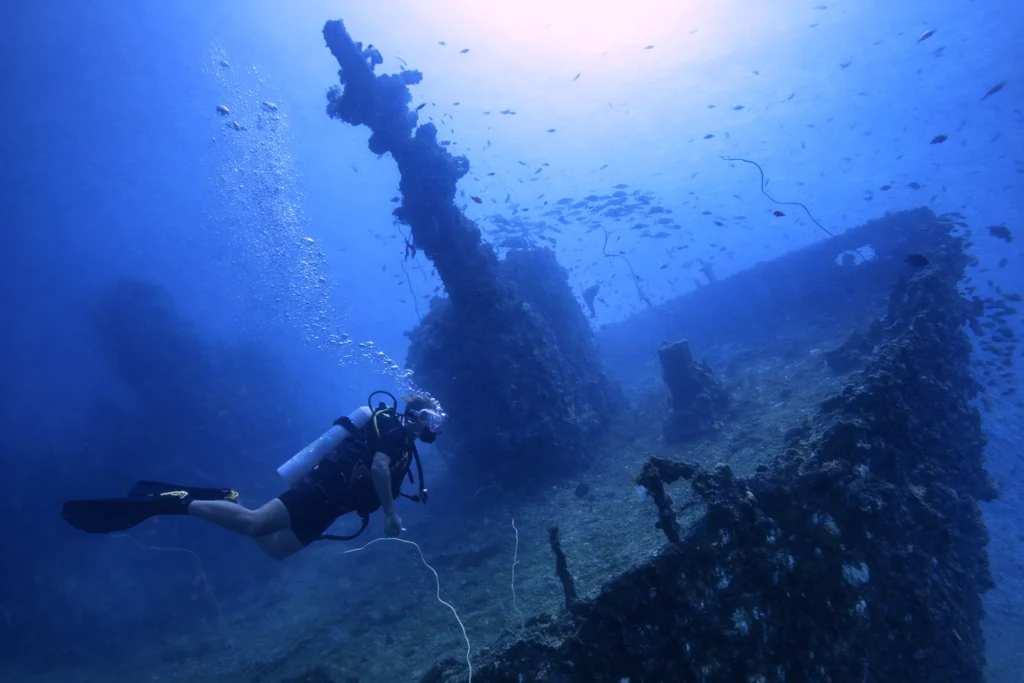
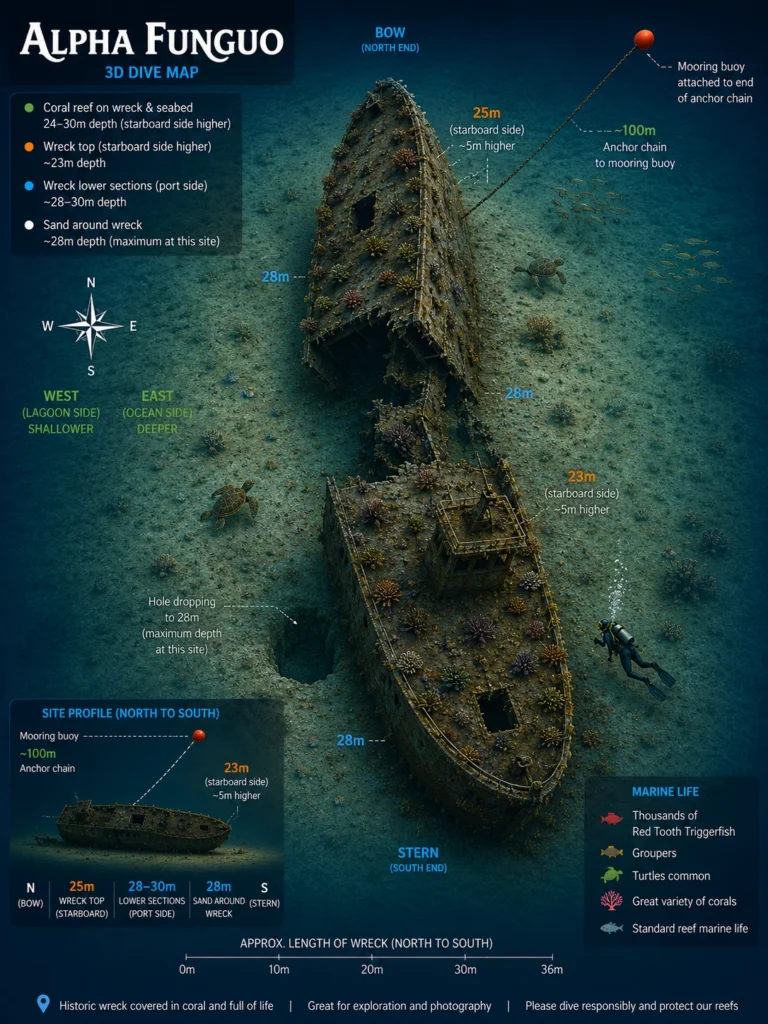
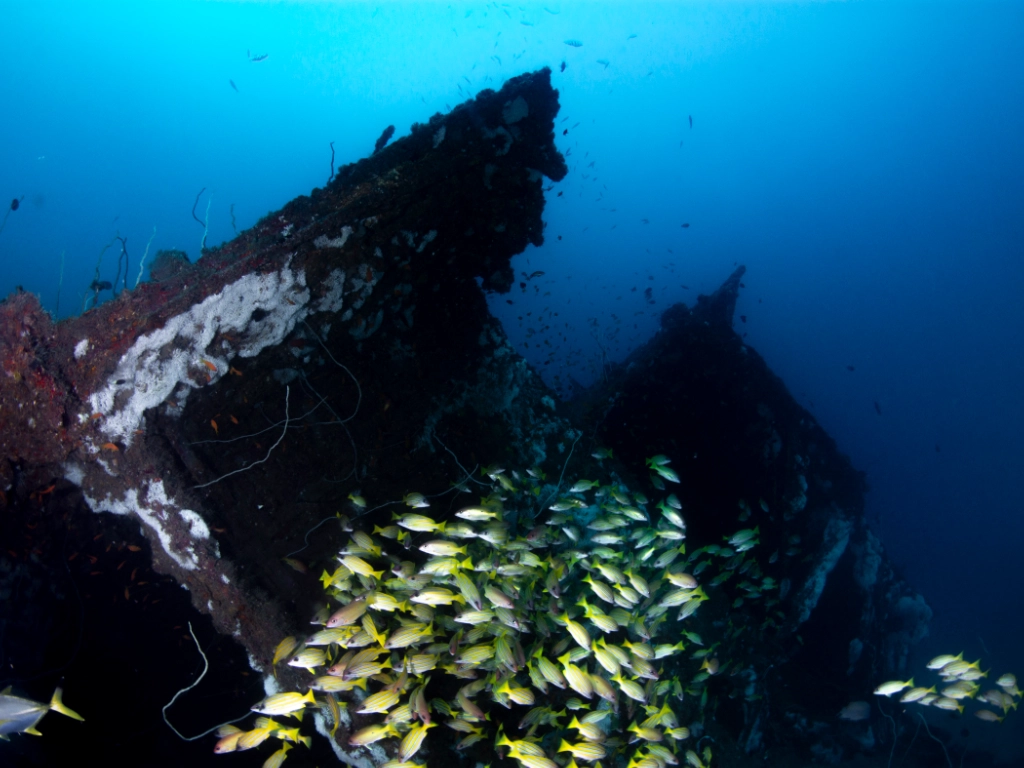
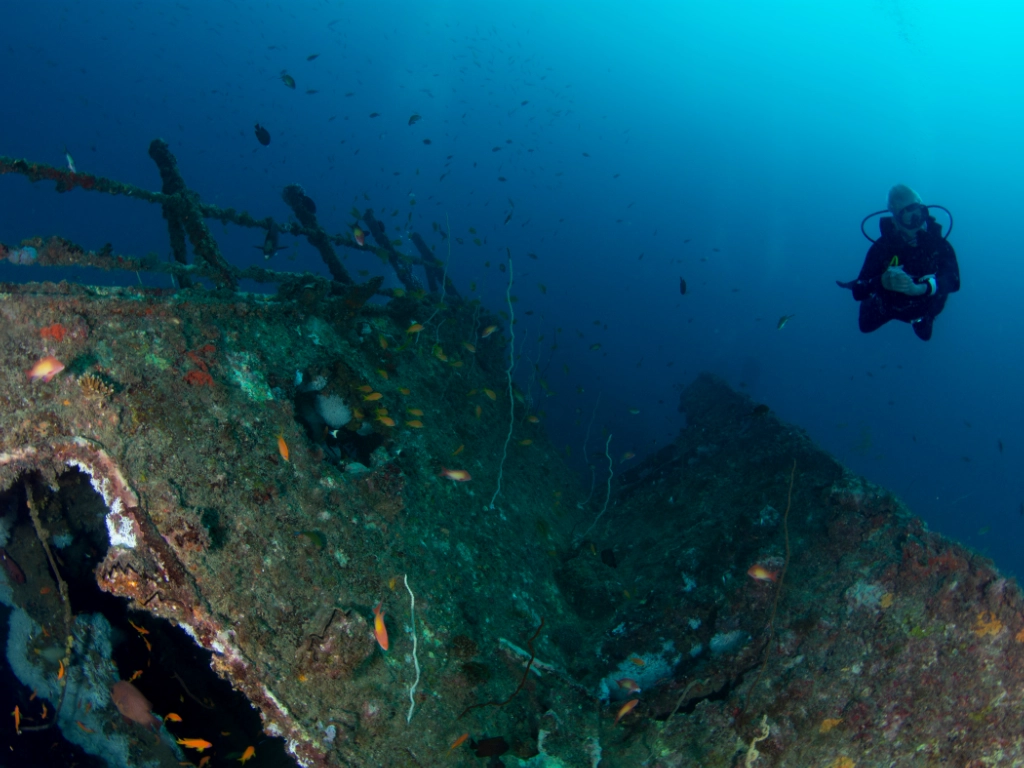
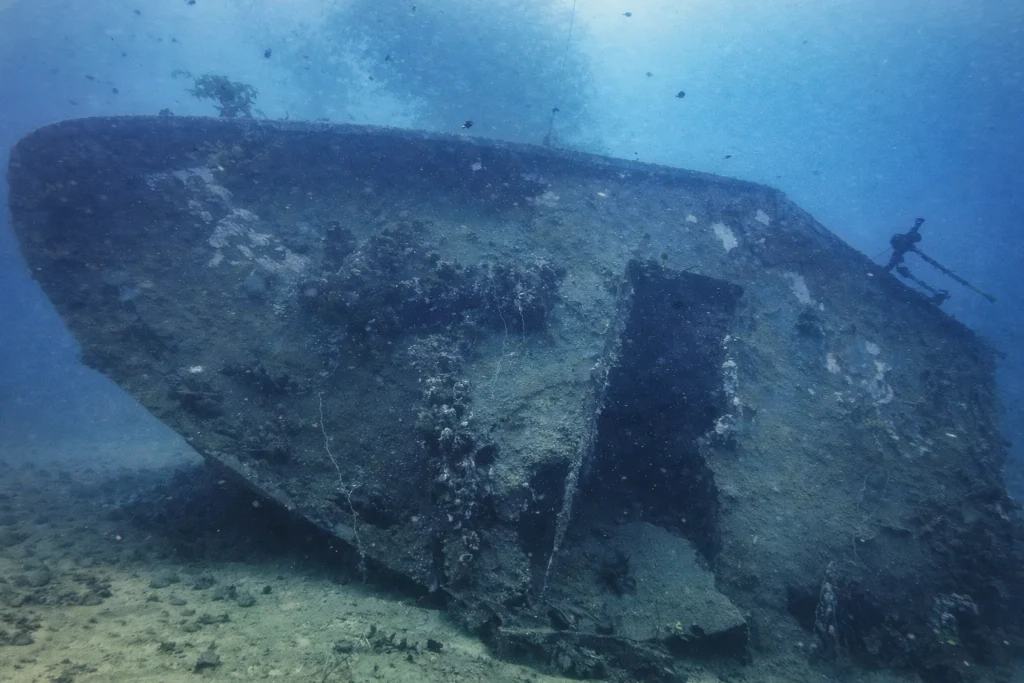
Ocean Tribe in Diani Beach, Kenya, runs the SSI Advanced Wreck Diving Course on what is arguably one of East Africa’s most rewarding training wrecks: the MV Alpha Funguo. The wreck sits in 22 to 30 metres of clear, warm Indian Ocean water, just a ten-minute boat ride from the dive centre, making it an ideal site to learn basic wreck penetration in real-world conditions.
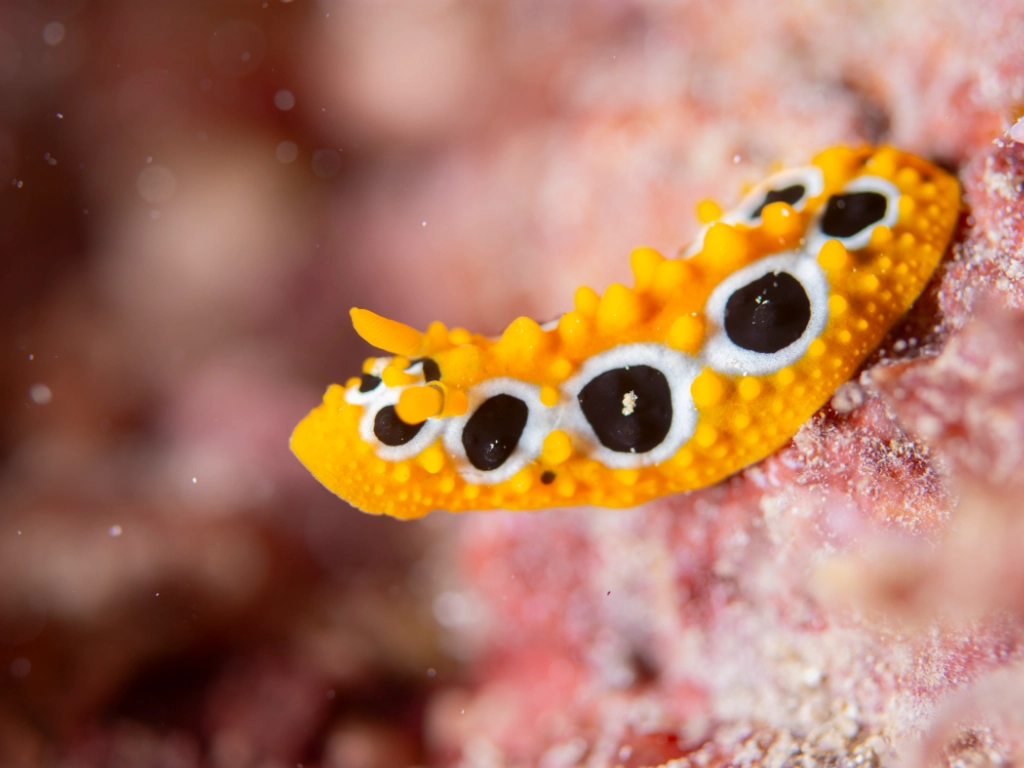
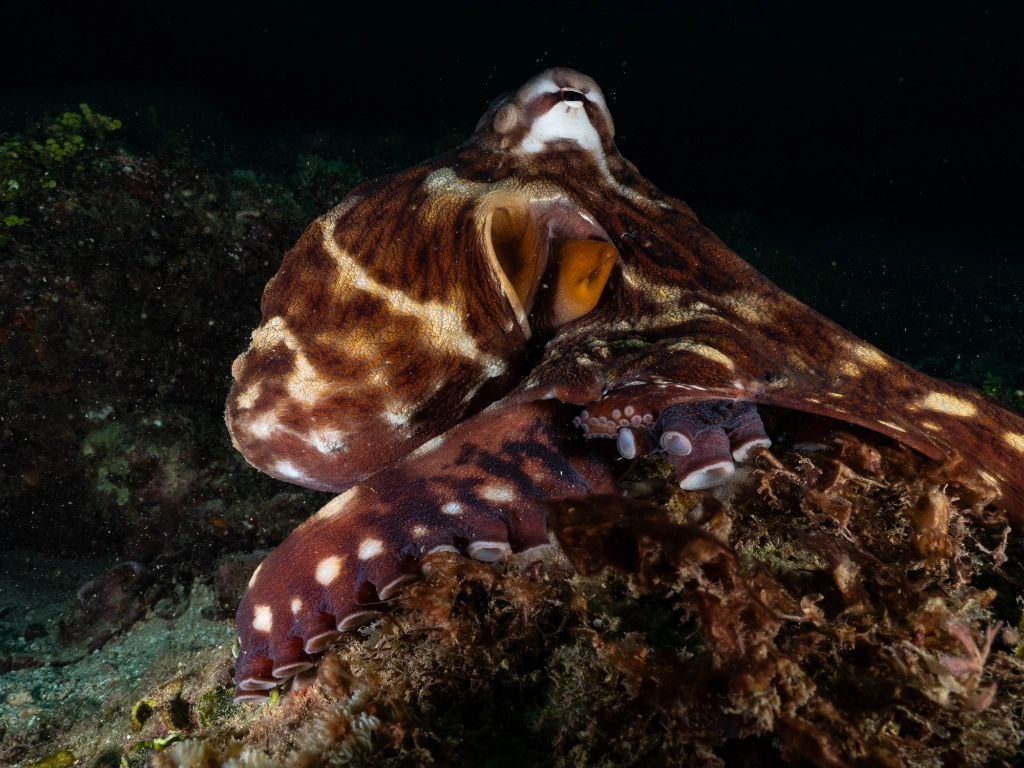
The Alpha Funguo rests upright, leaning slightly to one side, with her deck, cargo holds, and superstructure still intact — the perfect canvas for a course built around mapping, light use, and controlled penetration through known entry points. Around the wreck, schools of barracuda, snapper, jackfish, and batfish swirl through the blue, while moray eels, frogfish, scorpionfish, nudibranchs, and the occasional octopus tuck into the wreck’s crevices. Whitetip reef sharks, kingfish, and stingrays make regular appearances. For a recreational training wreck, it is unusually photogenic — and the visibility tends to cooperate.
The course is delivered over two days. Day one covers orientation, briefings, the knowledge review, and dives one and two. Day two adds a dry-land line-laying practice session before dives three and four. SSI’s digital learning is completed beforehand in the MySSI app, so classroom time is replaced with structured pre-dive briefings and in-water teaching.
Why It Is a Great Course to Take
A few reasons stand out. First, the SSI Advanced Wreck Diver certification opens up a genuinely different category of diving — overhead environment diving, with the equipment configuration, dive-planning discipline, and team awareness it demands. Those habits transfer directly to deep diving, sidemount, and any future technical training.
Second, the Alpha Funguo is the ideal training platform. Most wreck courses are taught on whatever wreck happens to be local; here, the wreck has been selected and is regularly dived for precisely this purpose, with controlled entry points and a known internal layout.
Third, the course is excellent value. At Ocean Tribe it is currently priced at $299, including all digital materials, equipment, air fills, weights, and refreshments on the boat. Four training dives on a flagship wreck for that price is hard to find anywhere in the Indian Ocean region.
Finally, it is simply a course that changes the way you dive. After completing the SSI Advanced Wreck Diving program, you stop seeing a wreck as a single object to swim around. You start seeing it as a place — with rooms, routes, history, and risks worth respecting. That shift in perspective is the real certification.
That is a perfectly reasonable choice — and you have options. Wreck penetration is not for everyone, and there is genuine value in diving wrecks from the outside, where the marine life and structure are often the highlight. Ocean Tribe runs the SSI Wreck Diving Specialty Course as a non-penetration alternative. The SSI Wreck Diving program gives you the knowledge and skills to safely conduct exterior, no-penetration dives around wrecks and artificial reefs — wreck research, gas planning, mapping, hazard awareness, and how to navigate around a wreck without ever entering it. It is the right course if you want to dive the MV Alpha Funguo confidently and competently without ever crossing an overhead-environment threshold. You can also simply enjoy the Alpha Funguo as a guided recreational dive without enrolling in either course, provided you are within depth limits for your current certification.
What is the difference between SSI Wreck Diving and SSI Advanced Wreck Diving?
The SSI Wreck Diving Specialty is a non-penetration course focused on diving safely around the outside of wrecks. The SSI Advanced Wreck Diving Specialty is where you learn basic wreck penetration — laying guidelines, using primary and backup lights, managing overhead-environment risks, and conducting limited interior penetrations within the daylight zone. They are complementary courses; many divers take the Wreck Diving course first and progress to Advanced Wreck later.
Do I need prior wreck-diving experience to enrol?
No prior wreck-specific experience is required, but you do need to be SSI Deep Diving or Advanced Open Water certified, be at least 15 years old, and have 20 logged dives. Comfort with buoyancy and trim is far more important than a logbook full of wrecks.
Is the SSI Advanced Wreck Diver course a technical diving course?
No. It is a recreational specialty with strict limits: no decompression, daylight zone only, maximum penetration depth of 30 metres, and a maximum linear penetration distance of 40 metres. If you want to go further or deeper into wrecks, the next step would be a TDI Advanced Wreck or Extended Range Wreck programme.
How deep will I go during the course?
Training dives are conducted on the MV Alpha Funguo, which sits between 22 and 30 metres. The maximum allowed training depth for the course is 40 metres, but most of the work happens between roughly 20 and 28 metres so that bottom times remain comfortable for skill development.
What equipment do I need to bring?
For the SSI Advanced Wreck Diving Course at Ocean Tribe, all standard scuba equipment, air fills, and weights are included. Specialised wreck-diving items — primary and backup lights, reels, and line — are supplied for the course. If you own your own dive light, slate, or diver’s tool, you are welcome to use them; otherwise everything you need is provided.
How long does it take to get certified?
Two days in the water, plus the SSI Digital Learning module that you complete in your own time before arrival via the MySSI app. Day one covers orientation, briefings, and dives one and two. Day two includes dry-land line-laying practice followed by dives three and four. You leave Diani as a certified SSI Advanced Wreck Diver.
Can I combine this with other specialty courses?
Yes — and many divers do. The Advanced Wreck Diving Course pairs particularly well with the SSI Deep Diving, Enriched Air Nitrox, and Recreational Sidemount courses. Ocean Tribe also offers multi-specialty packages such as the Mission Ready Diver package (Wreck, Deep, Sidemount, and Nitrox). Ask at booking for current combination pricing
There’s a moment every diver remembers. You drop down through the warm Indian Ocean, the reef sharpens into focus, and a hawksbill glides past you with the calm of something that has been doing this for a hundred million years. It changes you. It is also exactly the moment our SSI Sea Turtle Ecology specialty is designed to deepen — turning a beautiful encounter into a lifelong understanding of who these animals are, how they live, and why they need us.
If you are diving with Ocean Tribe in Diani, this is the eco specialty we recommend you book first. Here’s why.
Why Diani Is One of the Best Places on Earth for Sea Turtle Ecology
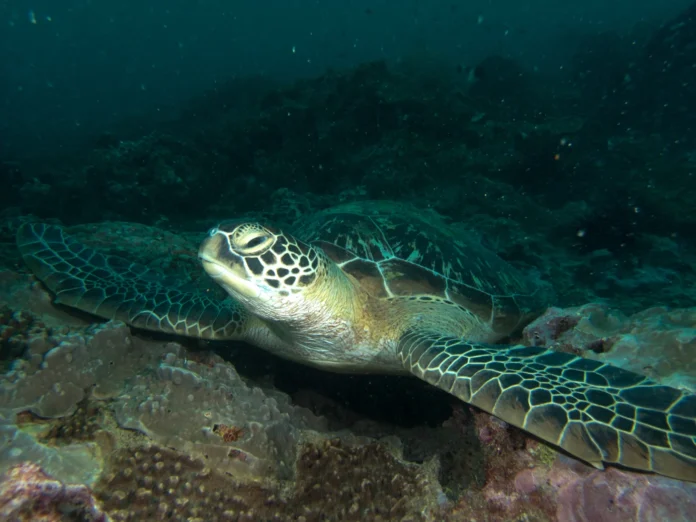
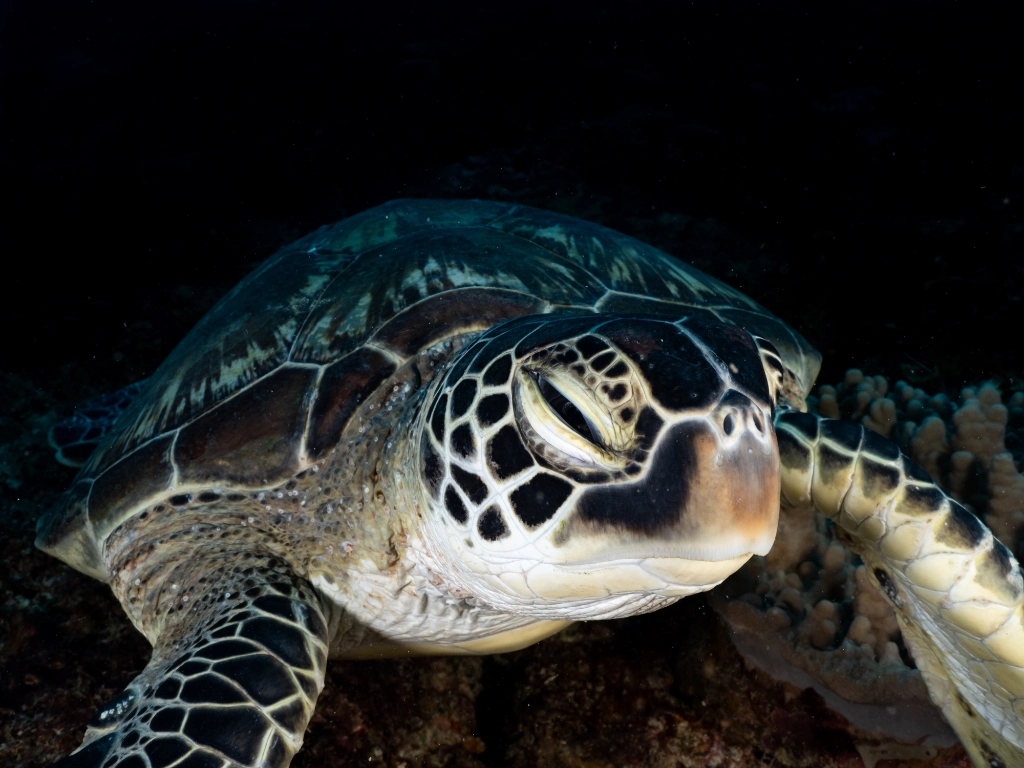
Diani sits on Kenya’s south coast, fringed by a healthy patchwork of reef, seagrass meadows and protected nesting beaches. Two species are part of everyday life here: the green turtle, which grazes our seagrass beds keeping them short, productive and healthy, and the hawksbill turtle, the pointy-beaked reef dweller that picks invertebrates and sponges from the coral. On many of our dive sites — Galu, Kinondo, Mwanyaza, the MV Alpha Funguo wreck — turtle sightings are not an “if”, they are a “when”.
That makes Diani the perfect classroom. You learn the theory in the morning. You meet your subject in the afternoon. The textbook closes the moment a green turtle looks you in the eye.
What Is the SSI Sea Turtle Ecology Specialty?
The SSI Sea Turtle Ecology program is flexible. You can take it as a non-diving course, or you can add a dive. Either way, it builds working knowledge of the seven living sea turtle species. These include the leatherback, green, loggerhead, hawksbill, olive ridley, flatback and Kemp’s ridley.
In addition, the course is built around five focused academic sessions. Together, they take about three hours in the classroom. Of course, there is also an optional ocean dive to put your new skills to use.
You do not need to be a certified diver to enrol in the theory. However, the experience dive requires Open Water certification. Alternatively, you can combine the specialty with your Open Water course while you are with us.
Course Highlights — What You’ll Actually Learn
The SSI Sea Turtle Ecology specialty is built around five sections. Each one peels back another layer of the turtle’s world.
1. Sea Turtle Species
First, you learn to tell a hawksbill from a green at a glance. We cover shell shapes and the scutes that armour them. Then we look at the prefrontal scales, colouration and geographic range. As a result, you walk away with the same toolkit researchers use on the reef.
2. Nests, Eggs and Hatchlings
This is the section that turns most students into turtle nerds for life. For example, you’ll learn how females haul up the beach at night. Then they dig with their hind flippers. Each clutch contains over a hundred eggs. In addition, temperature inside the nest determines the sex of the hatchlings. Specifically, above 29 °C produces more females. Below that, more males emerge. Clearly, the implications for a warming planet are immediate.
3. Swimming and Migration
Sea turtles are some of the greatest navigators on the planet. For instance, leatherbacks cross entire oceans. Similarly, greens make round trips between Costa Rica and the Caribbean. In this section, you’ll learn how flipper shape and an internal compass make these journeys possible. As a result, you’ll understand why a turtle in Diani might have hatched a thousand kilometres away.
4. Living in the Sea
How does an animal that breathes air thrive in salt water? First, you’ll discover the tear glands that weep salt. Then you’ll learn about the scaled skin that locks moisture in. Finally, you’ll see why turtles are “late maturers”. Indeed, they take 20–25 years to reproduce. Therefore, every adult is precious.
5. Threats and Conservation
This is where sea turtle ecology becomes personal. For example, boat strikes and ghost nets harm thousands of turtles every year. In addition, plastic pollution, coastal lighting and habitat loss all take their toll. However, you’ll also see clearly what you, as a diver, can do about it.
Why Divers (and Non-Divers) Should Take This Course
Have you ever surfaced grinning because you swam beside a turtle? Then this course is the natural next step. Here are a few reasons our students rave about it.
Every dive after it is better. First, you can identify species. Then you start reading body language. As a result, you stop just seeing turtles and start understanding them.
It’s accessible to everyone. The classroom is open to ages 10 and up. Moreover, no certification is needed. Snorkellers, families and divers are all welcome.
It’s fast and flexible. It takes about three hours in the classroom. In addition, SSI’s digital learning lets you start at home through the free MySSI app. The optional dive then slots straight into your Diani trip.
It counts towards SSI recognition. Specialties paired with logged dives stack toward SSI ratings. These include Specialty Diver, Advanced Open Water Diver and Master Diver.
It turns curiosity into conservation. Indeed, you walk away as an ocean advocate. That matters, because Kenya’s turtles need them.
Why Ocean Tribe in Diani Is the Right Place to Do It
We have been teaching SSI eco specialties on Diani Beach for years. In fact, sea turtle ecology is one of our favourites to run. The course is offered daily. It includes digital learning, all training materials and transfers within Diani. Prices start from $89.
Moreover, our instructors know the local reefs and the local turtles. Through community partnerships, they also know the local nesting beaches. As a result, the generic syllabus becomes something specific to your dives.
In addition, you can pair Sea Turtle Ecology with our other SSI ecology specialties. These include Coral Identification, Fish Identification, Marine Ecology, Manta & Ray Ecology and Shark Ecology. Together, they build a complete underwater naturalist’s toolkit while you are here.
Ready to Meet Diani’s Turtles Properly?
The reef is waiting. Right now, the green turtles are grazing the seagrass. Meanwhile, a hawksbill is almost certainly picking at a sponge off Galu. So take the SSI Sea Turtle Ecology specialty with Ocean Tribe. Then make the next encounter the start of something bigger.
Why Take Your Open Water Diver Course in Diani?- There’s a moment many divers remember forever. Standing on the boat in the warm sunshine, mask in hand, looking out across the Indian Ocean and thinking:
“I’ve always wanted to try diving…”
A few days later, that same person surfaces from their final dive smiling and saying:
“I’m a certified scuba diver.”
If you’ve been thinking about learning to dive, there are few better places in the world to start than Kenya’s tropical south coast. Taking your Open Water Diver Course in Diani combines warm clear water, colourful coral reefs, incredible marine life and relaxed beach vibes — all while learning a skill that can take you diving anywhere in the world.
At Ocean Tribe, we focus on making the experience safe, enjoyable, confidence-building and genuinely unforgettable.
Why Take Your Open Water Diver Course in Diani?
Warm Tropical Water All Year Round
One of the biggest advantages of learning in Diani Beach is the conditions. Warm Indian Ocean water means you can focus on learning and enjoying the experience rather than battling cold temperatures or heavy equipment.
The relaxed environment helps nervous beginners feel comfortable quickly, especially compared to colder destinations where learning can sometimes feel overwhelming.
Incredible Marine Life From Day One
Even during training dives, students regularly encounter amazing marine life on Diani’s reefs.
You may see:
Sea turtles
Dolphins
Reef sharks
Eagle rays and stingrays
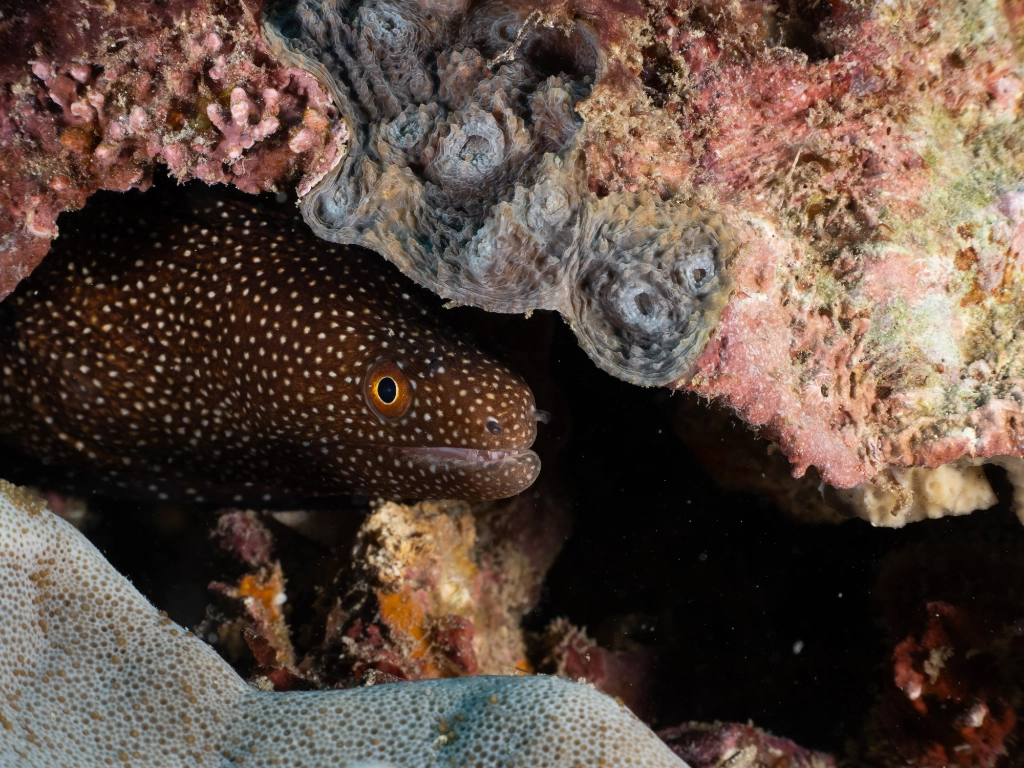
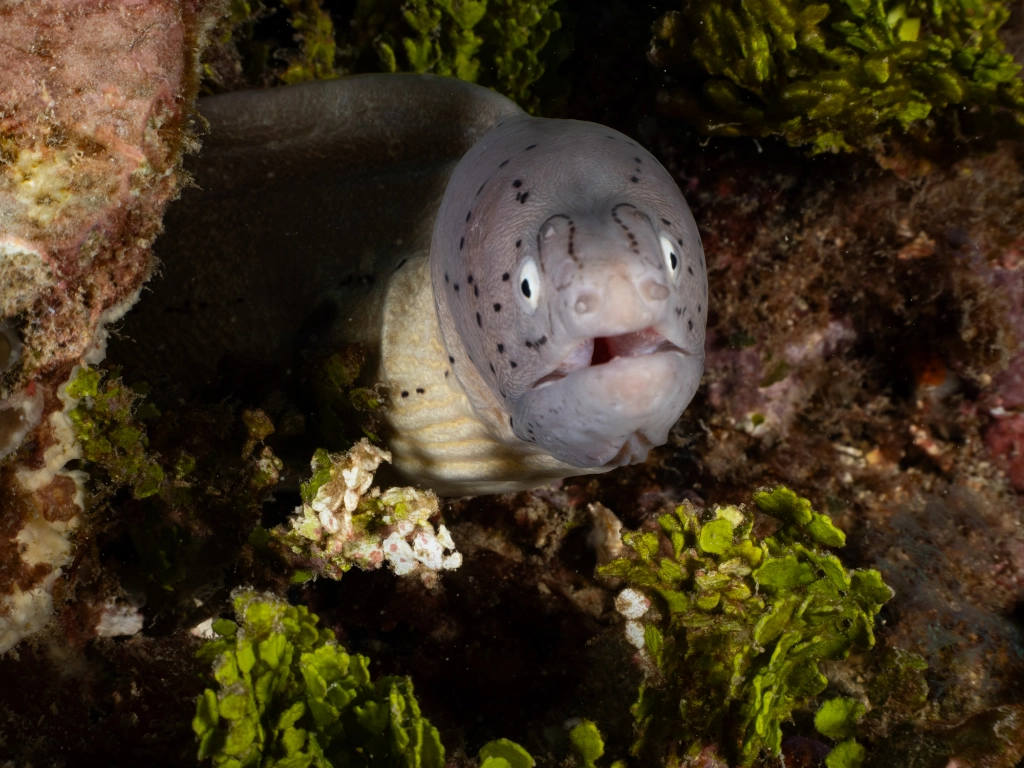
Moray eels
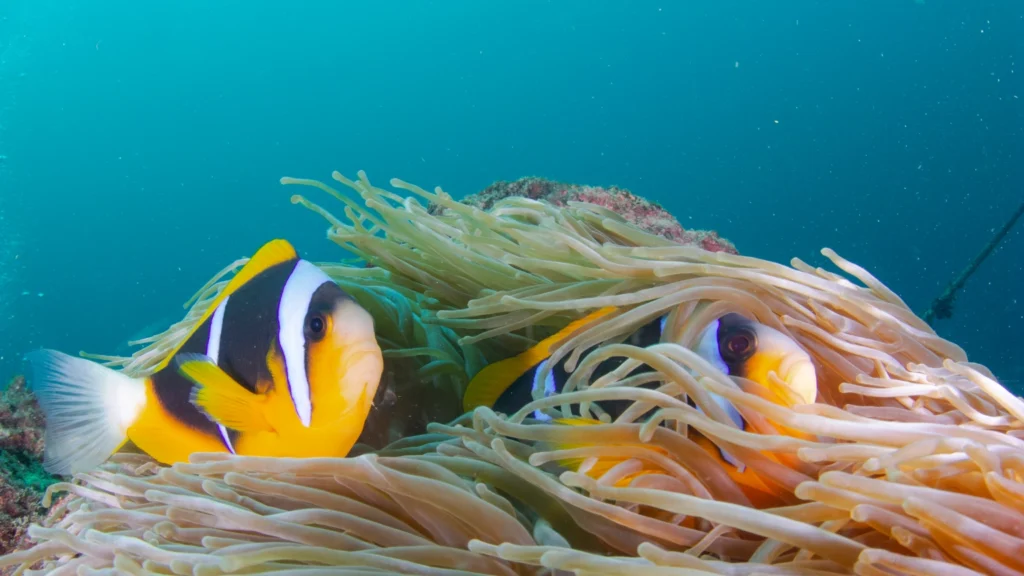
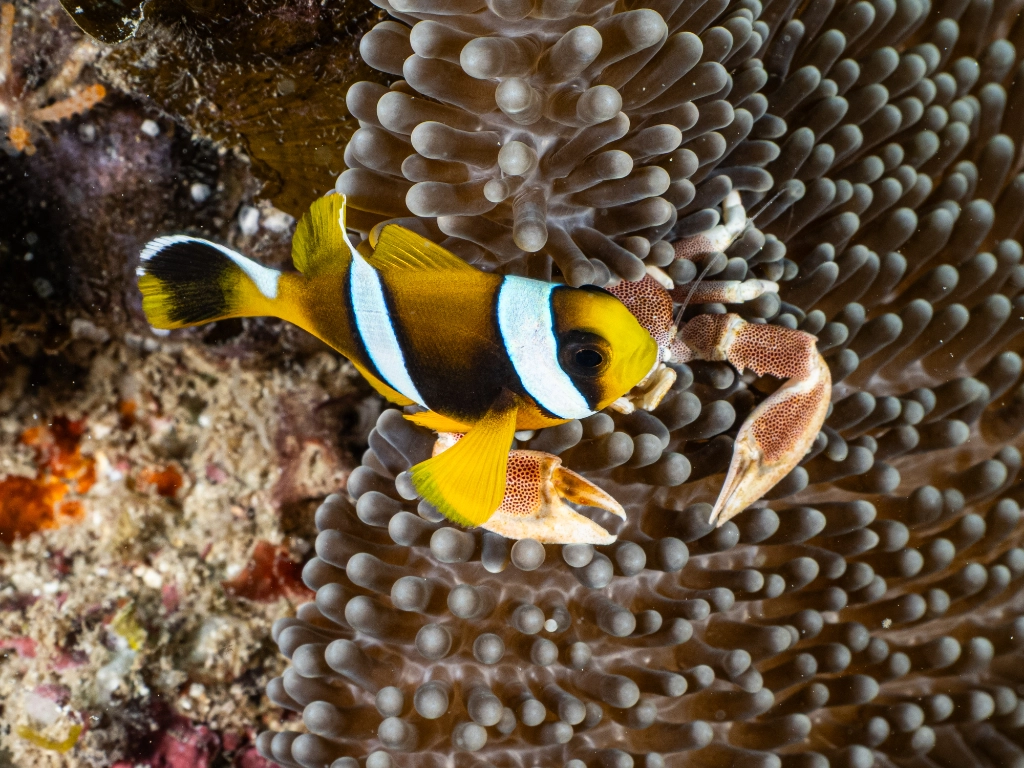
Clownfish
Pufferfish
Huge schools of tropical reef fish
Beautiful coral reefs
Learning to dive becomes far more exciting when your classroom includes coral gardens and tropical marine life.
Why Do Your Open Water Course With Ocean Tribe?
Free Digital Learning – Start Today Before You Commit
One thing students love is that you can begin the SSI digital learning completely free before fully committing to the course.
This allows you to:
See if scuba diving feels right for you
Learn the basics at your own pace
Explore the MySSI app
Start getting excited immediately
There’s no pressure and no classroom stress. You can start learning from your phone, tablet or computer today.
Super Qualified and Experienced Instructors
Ocean Tribe is an SSI Diamond Instructor Training Centre and home to the region’s only resident SSI Instructor Trainer.
That matters because instructor quality makes a huge difference to your experience.
Our team has extensive experience teaching:
Complete beginners
Nervous divers
Children and families
Divers with disabilities
Private students
Professional level divers
The goal isn’t just certification. It’s helping you become a genuinely comfortable and confident diver.
Safety First – Build Confidence Properly
At Ocean Tribe, we never rush students through skills.
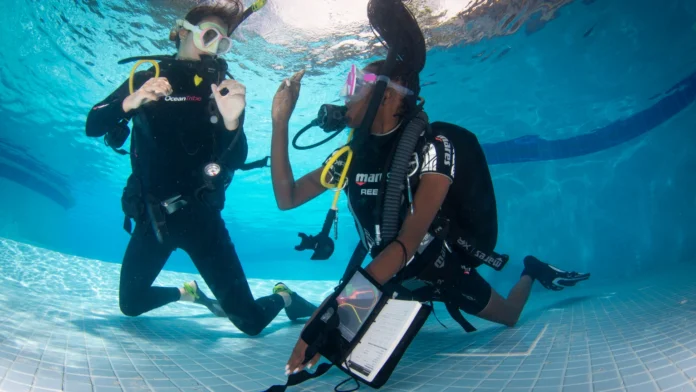
We keep students in confined water until skills are comfortable and confidence levels are strong. That means when you reach the ocean dives, you’re in a far better position to relax and actually enjoy the experience.
Many students tell us this slower, supportive approach makes all the difference.
Extra Day Diving Available
Want more experience before finishing?
You can add additional diving days if you wish, giving you extra time in the water right from the start. More diving early on often helps new divers become comfortable much faster.
It also means more opportunities to enjoy Diani’s reefs and marine life while building experience.
Small Groups and Private Courses
Nobody enjoys feeling rushed or lost in huge groups.
That’s why Ocean Tribe keeps training groups small and relaxed. Private Open Water courses are also available if you prefer:
One-to-one instruction
Family-only training
A personalised pace
Additional confidence-building time
This creates a much calmer learning environment for beginners.
Learn Together – Couples and Group Offers
Learning to dive is even more memorable when shared with people you care about.
Ocean Tribe offers special deals for:
Couples
Friends travelling together
Families
Small groups
It’s an unforgettable activity to experience together — and afterwards you’ll be certified to explore the underwater world anywhere on Earth.
Special Bundle Offers
Many students choose to continue training immediately after certification while their skills and confidence are growing quickly.
Ocean Tribe offers bundle packages that save money when courses are booked together.
Popular combinations include:
Open Water & Advanced Open Water
Continue straight into adventure dives and deeper exploration. Book Now
Open Water, Deep, Navigation & Nitrox
A fantastic package for divers wanting to progress quickly. Book Now
Open Water & Nitrox
Learn to dive while also becoming certified to dive with enriched air nitrox. Book Now
Open Water & Perfect Buoyancy
Develop excellent buoyancy control from the beginning and become a more relaxed diver. Book Now
Open Water & Diver Stress and Rescue
Build strong confidence and safety awareness from the very beginning while progressing rapidly as a diver. This package combines your beginner certification with essential rescue skills, self-rescue techniques and diver safety training. Book Now
Beginner Friendly Learning
No Experience Needed
You do not need:
Previous diving experience
Perfect fitness
Expensive equipment
Any prior knowledge
The course is designed specifically for beginners.
Nervous Beginners Welcome
Feeling nervous is completely normal.
Many divers arrive excited but anxious before their first session. A calm instructor, relaxed pace and supportive environment make a huge difference.
Ocean Tribe specialises in helping nervous divers feel comfortable.
Non-Swimmers Can Discuss Options
Strong swimming ability is helpful, but many people overestimate how athletic scuba diving actually is.
If you’re unsure whether diving is possible for you, contact Ocean Tribe to discuss your situation and possible options. Ocean Tribe does offer SSI Survival Swimming to get you started on your swimming journey.
Learn to Dive in Just 3 Days
The SSI Open Water Diver Course can normally be completed over 3 days.
The course includes:
Digital learning
Pool/confined water training
Open water dives in the ocean
Full equipment rental
Professional instruction
International certification
Once certified, you can dive anywhere in the world to depths of 18 metres with a buddy.
Before and After
Before
“I’ve always wanted to try diving…”
After
“I’m a certified scuba diver.”
That transformation happens surprisingly quickly.
Start Online Today
One of the best parts about the SSI system is that you can start learning online immediately.
Explore the first sections of the digital learning for free and begin your diving journey before you even arrive in Diani.
FAQs – Open Water Diver Course in Diani
How long does the Open Water Diver Course in Diani take?
Most students complete the course in around 3 days, although extra time can be added if you prefer a slower pace or additional diving experience.
Do I need previous diving experience?
No experience is needed at all. The course is designed specifically for complete beginners.
Is the course safe?
Yes. Safety is the top priority at Ocean Tribe. Students stay in confined water until skills and confidence are strong before progressing to ocean dives.
What equipment is included?
Full scuba equipment is included during the course.
Can nervous people learn to dive?
Absolutely. Many students are nervous at first. Small groups, experienced instructors and a relaxed pace help make the experience enjoyable and comfortable.
What marine life might I see during the course?
Students regularly encounter:
Turtles
Dolphins
Rays
Reef sharks
Moray eels
Tropical reef fish
Healthy coral reefs
Every dive is different.
Can couples or families learn together?
Yes. Ocean Tribe offers special options and discounts for couples, families and groups wanting to learn together.
What happens after I complete the course?
Once certified, you can scuba dive worldwide to depths of 18 metres with a buddy. Many students continue immediately into Advanced Open Water or specialty courses.
Can I start the theory before arriving?
Yes. SSI digital learning allows you to begin online today before starting practical training in Diani.
Why choose Ocean Tribe for my Open Water Diver Course in Diani?
Ocean Tribe combines:
Experienced instructors
Small groups
A safety-first approach
Flexible learning
Excellent marine life
SSI Diamond Instructor Training Centre status
Relaxed tropical conditions
Optional private courses
Extra diving opportunities
The result is a fun, supportive and memorable way to learn scuba diving in Kenya.
Many children dream of breathing underwater and exploring the ocean like a real-life explorer. The good news is that there are now excellent programs designed specifically for scuba diving for children, allowing young divers to learn safely, build confidence, and discover the underwater world in a fun and controlled environment.
At Ocean Tribe in Diani Beach, Kenya, we offer a range of kids’s scuba experiences through the SSI Explorers program and beginner try dives. Whether your child simply wants to try scuba once or begin a full junior certification pathway, there are options available for different ages and experience levels.
Can Kids Really Go Scuba Diving?
Yes — absolutely. Modern scuba training agencies such as SSI have created specialised youth programs that introduce diving gradually and safely.
Children learn using:
Smaller equipment designed for younger divers
Shallow water limits
Highly supervised training
Fun, game-based learning methods
Age-appropriate teaching techniques
The focus is not just on diving skills, but also on:
Water confidence
Ocean awareness
Safety habits
Marine conservation
Teamwork and responsibility
For many families visiting Diani Beach, scuba diving for children becomes one of the highlights of the holiday.
What Age Can Kids Start Scuba Diving?
The minimum age depends on the type of program.
Ages 6–11: SSI Explorers Program
The SSI Explorers program is specifically designed for younger children and introduces them to different underwater activities in a safe and exciting way.
Children aged 6 and above can participate in selected Explorer activities such as:
Snorkelling
Marine ecology
Ocean education
Mermaid sessions
Pool confidence activities
The scuba diving portion of the Explorers program starts from 8 years old, allowing children to experience real scuba diving in shallow confined water under close professional supervision.
The program keeps things fun while gradually teaching important diving principles.
Unlike adult courses, the emphasis is on:
Enjoyment
Confidence building
Comfort in the water
Exploration
Many children love collecting Explorer recognition cards and progressing through different adventure modules.
Ages 10+: Junior Open Water Diver
From age 10, children can complete a full internationally recognised junior scuba certification.
After certification, junior divers can dive worldwide within age-specific depth limits and supervision requirements.
This course is ideal for:
Confident swimmers
Ocean-loving kids
Families who dive together
Children wanting a real scuba certification
Continuing Education for Young Divers
Scuba diving for kids does not stop after the first certification. Young divers can continue developing their skills through a wide range of junior-friendly continuing education programs.
Depending on age and experience, children may progress into:
Become more comfortable in different diving conditions
Many children who begin with Explorers later progress into full junior certifications and eventually become passionate lifelong divers.
The SSI Explorers Program
The SSI Explorers program is one of the best ways to introduce scuba diving for children because it combines education with adventure.
At Ocean Tribe, children can experience:
Pool scuba sessions
Snorkel Explorer
Ecology Explorer modules
Mermaid programs
Underwater photography introductions
Marine life awareness
Buoyancy games and underwater challenges
The sessions are designed to be interactive and exciting rather than classroom-heavy.
Children often gain:
Improved water confidence
Better swimming comfort
Environmental awareness
New friendships
A lifelong passion for the ocean
Is Scuba Diving Safe for Kids?
When taught correctly by experienced professionals, scuba diving for children is very safe.
At Ocean Tribe:
Training ratios are kept small
Sessions are supervised closely
Equipment is properly sized
Programs follow SSI safety standards
Conditions are carefully selected
Skills progress gradually
Not every child is ready at the same age, and good instructors will always prioritise comfort and confidence over pushing progression too quickly.
The best young divers are usually:
Comfortable in the water
Good listeners
Calm and patient
Excited to learn
Why Diani Beach Is Great for Scuba Diving for Children
Diani Beach offers ideal conditions for introducing children to scuba diving.
The area features:
Warm tropical water
Gentle conditions
Shallow reefs
Colourful marine life
Good visibility
Calm lagoon areas
Young divers may encounter:
Clownfish
Sea turtles
Pufferfish
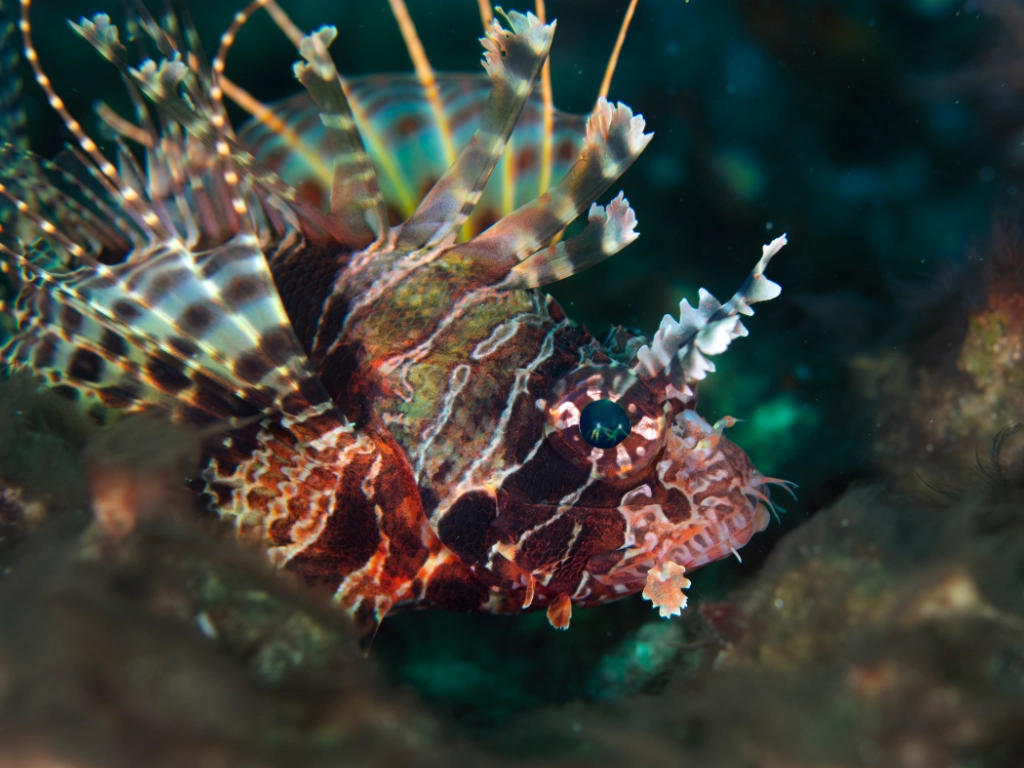
Lionfish
Moray eels
Rays
Schools of reef fish
Because the reefs are close to shore, trips are shorter and less tiring for younger children.
Family Diving Holidays in Kenya
One of the best things about scuba diving for children is that it allows families to share the experience together.
Many families choose to:
Learn together
Combine adult and junior courses
Snorkel and dive as a group
Continue diving on future holidays
Parents are often surprised by how quickly children adapt underwater. Many kids become naturally relaxed divers because they approach the experience with curiosity rather than anxiety.
Scuba diving can become a shared family activity that creates unforgettable travel memories.
Special Summer Holiday Family Offer
This summer, Ocean Tribe is running a special family diving offer for visitors to Diani Beach.
Family Dive Offer
When 2 adults book diving courses, up to 2 children can do the dive course for half price.
This offer is ideal for:
Family holidays in Kenya
Parents wanting to introduce children to diving
Junior certification programs
SSI Explorers experiences
Shared family adventures underwater
Contact Ocean Tribe directly for current terms, availability, and qualifying programs.
Dive Club Options for Kenya Residents
For families living in Kenya, diving does not have to be just a once-a-year holiday activity.
Ocean Tribe also offers access to the Ocean Tribe Dive Club, giving resident divers and families opportunities to continue diving regularly throughout the year.
Benefits may include:
Discounted diving
Training offers
Family-friendly dive events
Social activities
Continuing education opportunities
Equipment discounts
Access to a growing local dive community
The club can be a fantastic way for young divers to continue building confidence and experience after their first courses.
Start Your Child’s Underwater Adventure
If you are considering scuba diving for children, Diani Beach offers one of the most exciting places in Africa to begin.
From fun SSI Explorers sessions to full junior scuba certifications, Ocean Tribe provides safe, professional, and enjoyable experiences for young ocean explorers.
Whether your child wants to try breathing underwater for the first time or begin a lifelong diving journey, there is a program designed specifically for them.
FAQs About Scuba Diving for Kids
What is the minimum age for scuba diving for kids?
Children can join selected SSI Explorers activities from age 6. The actual scuba diving portion of the SSI Explorers program starts from 8 years old in shallow confined water sessions under close professional supervision.
Children can complete the SSI Junior Open Water Diver certification from 10 years old.
Is scuba diving for kids safe?
Yes — when conducted through recognised training agencies such as SSI and supervised by qualified professionals, scuba diving for kids is very safe.
Programs are specifically adapted for younger divers with:
Smaller equipment
Shallow depth limits
Close supervision
Gradual skill progression
Child-friendly teaching methods
At Ocean Tribe, safety and comfort always come first.
Do kids need to be strong swimmers?
Children should be reasonably comfortable in the water, but they do not need to be competitive swimmers.
Confidence, calmness, and willingness to learn are usually more important than advanced swimming ability.
What is the SSI Explorers program?
SSI Explorers is a youth adventure program designed for children aged 6–11.
It includes:
Scuba experiences
Snorkelling
Mermaid programs
Marine ecology
Ocean education
Underwater games and activities
It is one of the best introductions to scuba diving for kids because it focuses on fun, confidence, and exploration.
Can children get a real scuba certification?
Yes. From age 10, children can complete the SSI Junior Open Water Diver course and earn an internationally recognised scuba certification.
This allows them to dive worldwide within junior depth and supervision limits.
Can families dive together?
Absolutely. Many families complete courses together or combine diving and snorkelling activities during their holiday.
Family diving holidays are one of the best ways to introduce children to the underwater world while creating unforgettable shared experiences.
What marine life might children see in Diani Beach?
Young divers in Diani Beach may encounter:
Sea turtles
Clownfish
Pufferfish
Lionfish
Rays
Moray eels
Colourful coral reef fish
The warm water and shallow reefs make the area ideal for beginner and junior divers.
Is there a family diving offer available?
Yes. Ocean Tribe currently offers a special summer holiday promotion:
Family Offer
When 2 adults book diving or courses, up to 2 children dive for half price.
Contact Ocean Tribe directly for details, qualifying programs, and availability.
Can kids continue diving after their first course?
Yes. Young divers can continue into junior continuing education programs such as:
Perfect Buoyancy
Marine Ecology
Navigation
Junior Advanced Open Water
Science of Diving
As they grow older, they can continue progressing through the full recreational scuba pathway.
Is there a dive club for families living in Kenya?
Yes. Kenya residents can join the Ocean Tribe Dive Club, which offers ongoing diving opportunities, social events, discounts, and continuing education for both adults and young divers.
It is a great option for children who want to continue diving regularly after their first experience or certification.
What equipment do children use?
Children use properly fitted junior scuba equipment designed specifically for smaller divers, including:
Junior BCDs
Small masks and fins
Lightweight tanks
Child-sized wetsuits
Properly fitted equipment helps children feel more comfortable and confident underwater.
What if my child feels nervous?
That is completely normal. Good instructors never rush children into diving.
Sessions are designed to progress slowly and positively so children can build confidence at their own pace. Many nervous children quickly become relaxed and enthusiastic once they experience breathing underwater.
I have heard PADI courses are more valuable. Is this true?
No — SSI and PADI certifications are both internationally recognised and accepted worldwide.
A child who completes an SSI junior certification can dive with dive centres across the world in exactly the same way as a PADI-certified diver. The same applies as they continue into higher-level courses later on.
The most important factor is not the logo on the certification card, but:
The quality of instruction
Small group sizes
Good supervision
Safe diving practices
Building genuine confidence and skills underwater
Many families choose SSI programs because they offer:
Excellent digital learning through the MySSI app
Flexible training options
Modern teaching systems
Strong continuing education pathways
Great value for families
At Ocean Tribe, we focus on creating confident, safe, and enthusiastic young divers — regardless of agency branding.
If you’ve decided to learn to scuba dive, you’ve almost certainly stumbled across the same question every new diver lands on: what is the difference between PADI Open Water and SSI Open Water? Both are entry-level scuba certifications. Both let you dive to 18 metres with a buddy, anywhere in the world. Both are taught by professionals trained to international safety standards. So why does it even matter which one you pick?
At Ocean Tribe, we get asked this almost daily by guests planning their first dive trip to Kenya. The honest answer is that the difference between PADI Open Water and SSI Open Water is smaller than most people think — but the gap is in exactly the places that affect how you learn, how much you pay, and how comfortable you feel underwater. This guide walks through every meaningful difference so you can show up on the boat at Diani knowing exactly what you’re signing up for.
PADI vs SSI: A Quick Introduction
Before we get into the difference between PADI Open Water and SSI Open Water, a quick word on the two agencies themselves.
PADI (Professional Association of Diving Instructors) was founded in 1966 in the United States and is the largest and most heavily marketed dive training organisation on the planet. Most travellers have heard of PADI before they’ve heard of any other agency, and many people walk into a dive centre asking to “do their PADI” without realising other options exist.
SSI (Scuba Schools International) was founded in 1970 and is the world’s largest store-based training agency. SSI instructors must teach through an authorised SSI dive centre, which means the centre and the instructor share responsibility for the quality and safety of your training.
Both agencies are full members of the World Recreational Scuba Training Council (WRSTC), the international body that sets minimum standards for recreational dive training. That’s the critical bit: PADI and SSI follow the same safety standards, teach the same core skills, and produce the same kind of certified diver at the end of the course.
Are PADI and SSI Open Water Certifications Equally Recognised?
This is usually the first worry: “If I do an SSI Open Water in Kenya, will I be able to dive in Thailand, Egypt, the Caribbean or the Maldives next year?”
Yes. Unambiguously, yes.
A PADI Open Water Diver card and an SSI Open Water Diver card carry the same global recognition. Any reputable dive centre worldwide accepts both certifications, and you can switch agencies as you progress. You might do Open Water with SSI, Advanced with PADI, a specialty with NAUI, and Rescue Diver with SSI. You won’t need to repeat the same course at the same level.
So when people compare the difference between PADI Open Water and SSI Open Water, in terms of where the card is accepted. There is no difference. Both are honoured worldwide.
Course Structure: Where the Real Difference Begins
Both courses cover the same essential content. Dive theory, equipment skills, confined-water training (in a pool or shallow protected water), and four open-water training dives. What changes between the two is how those skills are taught.
PADI’s teaching model is rigid. Instructors must teach skills in a fixed sequence laid out by the agency. If a student is struggling with a particular skill — say, mask-clearing or regulator recovery — the instructor cannot legally move on to other skills first and come back later. The student has to keep trying until they nail the skill in front of the rest of the class, or the course pauses. Deviating from the prescribed order is a standards violation for the instructor.
SSI’s teaching model is flexible. SSI uses an 80/20 framework: 80% of the course is fixed content set by the agency, but 20% can be adapted by the instructor to suit the student. If you’re struggling with one skill, your SSI instructor can move you on to a couple of easier skills, build your confidence, then return to the tricky one later when you’re relaxed. Instructors can also add extra information or drills if it improves the quality of the diver.
For most beginners, this flexibility is the single most important practical difference between PADI Open Water and SSI Open Water. It tends to result in less stressed students, lower drop-off rates, and divers who finish the course feeling genuinely competent rather than just relieved it’s over. It’s a big part of why Ocean Tribe runs SSI as our primary agency — Diani’s warm, calm reef conditions are perfect for a paced, confidence-first approach.
Theory and Learning Materials: Paper, Apps and eLearning
Both agencies have moved most of their theory online, but the experience is different.
PADI’s eLearning is paid. You pay for access to the online course, and you typically retain that access for a limited window. You can access this via the PADI app or online in a browser. If you prefer paper, PADI sells physical manuals that you’re expected to keep for post-course review. Either way, the materials are an extra cost on top of the course fee.
SSI’s digital learning is delivered through the MySSI app (iOS, Android, or browser) and is paid overall. The first four Open Water sections are free, so you can preview the course before committing. The full course costs less than PADI’s equivalent.
Once unlocked, your materials stay in your MySSI library for life—useful for refreshers anytime. Your certification card, dive log, specialty cards, and dive centre locator are all in one app.
PADI splits its digital ecosystem across two apps: the main PADI app and PADI Adventures. Even inside those, you often get bounced out to browser pages to finish tasks. It works, but it’s clunky. MySSI keeps everything in one app — theory, certifications, logbook, dive centre locator and dive site info — no redirects.
So on materials and digital experience, SSI tends to come out ahead — both on cost and on usability.
Cost: Is One Cheaper Than the Other?
Course prices vary widely by region, but as a general rule SSI Open Water courses are slightly cheaper than PADI Open Water courses, mostly because:
SSI digital learning is significantly cheaper than PADI’s eLearning (and the first four sections of the Open Water are free to preview).
SSI’s agency fees for dive centres and instructors are lower, so those savings pass through to students.
The price gap on the certification itself isn’t huge (often the equivalent of an extra fun dive plus a couple of post-dive beers), but when you factor in materials, it adds up. For backpackers and budget travellers diving in Diani, that difference is usually meaningful.
Skill Development in the Water
In confined water and on your four open-water dives, the skills you’ll perform are essentially identical: mask clearing, regulator recovery, buoyancy control, controlled emergency swimming ascents, buddy checks, and so on.
What changes is the feel of the training. Under PADI, the prescribed order means every student in the group works through the same skill at the same time, and you must master it before progressing. Under SSI, your instructor can group, re-order or revisit skills based on your comfort level, often spending more time on the things you find harder and breezing through the things that come naturally.
Many divers report feeling more relaxed underwater earlier in the course with SSI, simply because the structure is built around the student rather than the syllabus. That early confidence pays off when you start logging fun dives at Diani sites like Galu, Kinondo, Tiwi Wall or the MV Alpha Funguo wreck — places where calm, controlled buoyancy makes the difference between a good dive and a great one.
Certification Cards and Diver Recognition
Both agencies issue digital cards instantly on completion of your course, and both let you pay extra for a physical plastic card if you want one.
Where SSI pulls ahead is in diver recognition. SSI’s Diver Levels of Recognition system automatically promotes you up the ranks (Open Water Diver, Specialty Diver, Advanced Open Water Diver, Master Diver, and so on) as you log dives and complete specialties — at no extra charge. The card refreshes inside the MySSI app, which is a nice morale boost as your logbook fills up.
PADI charges a separate fee for higher recognition ratings like PADI Master Scuba Diver. The diving you’ve done is the same; the badge just costs more.
Going Pro: Why It Matters Down the Line
If your dream is to eventually become a Divemaster or Instructor — maybe even kick off a career change in Diani — the agency you pick at Open Water level isn’t locked in, but it does shape your pathway.
SSI Pro Rewards is a points-based programme where every course an SSI instructor teaches earns Pro Rewards points, which can offset annual renewal fees. For active, working instructors, it’s realistic to cover your annual renewal entirely through teaching, which is why so many career divers prefer SSI long-term.
PADI Pro+ Rewards is PADI’s more recent answer to the same idea — instructors earn rewards for certifications issued, which can be put towards renewal fees and other PADI services. It’s a welcome addition, but the structure, earn rates and overall value still tend to fall short of what SSI offers. We dug into the head-to-head in detail in SSI Pro Rewards vs PADI Pro+ Rewards: Has PADI Finally Caught Up? — short answer, not quite.
Quick Comparison Table: The Difference Between PADI Open Water and SSI Open Water
Feature
PADI Open Water
SSI Open Water
Global recognition
Yes
Yes
Depth limit
18 m
18 m
Theory delivery
PADI App/Browser paid eLearning or paper manual
MySSI app/Browser — first 4 sections free, full course paid (cheaper than PADI)
Skill order
Fixed sequence
Flexible 80/20 model
Typical price
Slightly higher
Slightly lower
Physical card
Paid Optional/ Instant Digital
Paid Optional/ Instant Digital
Single unified app
No (2 apps)
Yes (MySSI)
Diver recognition levels*
Paid upgrades
Free, merit-based
Pro renewal*
PADI Pro+ Rewards- Significantly higher base renewal rate
Pro Rewards offsets fee
Instructor affiliation*
Can teach independently
Must teach through a centre
*- These are not directly related to the Open Water Diver course but apply to descriptions of the differences between the two agencies as a whole.
So Which Should You Choose at Ocean Tribe?
Here’s the honest take. The difference between PADI Open Water and SSI Open Water at the recreational level is small enough that you’ll be a safe, confident, internationally recognised diver either way. The bigger choice — and the one we’d genuinely encourage you to focus on — is your dive centre and your instructor.
At Ocean Tribe, we’ve chosen SSI as our primary training agency because it matches how we like to teach: small group sizes, flexible pacing, and no embarrassment moments for nervous beginners. Plus a clean digital experience for students who’d rather not lug a paper manual through East Africa. Diani Beach is one of the easiest places in the world to learn to dive. It boasts warm water, gentle reefs, friendly turtles. SSI’s student-focused model lets us make the most of that.
If you’ve already done a PADI Open Water elsewhere and want to continue with us in Diani — no problem. We can pick you up at any level, and crossing between agencies for further training is seamless. The card in your wallet doesn’t change how welcome you are on our boat.
Frequently Asked Questions
Is SSI Open Water accepted at PADI dive centres worldwide?
Yes. Both PADI and SSI are members of the WRSTC and both certifications are accepted at any reputable dive centre globally.
Can I switch from SSI to PADI (or vice versa) after my Open Water?
Yes. You can do your Open Water with one agency and your Advanced, Rescue or specialties with another. No course needs to be repeated.
Is the PADI Open Water harder than the SSI Open Water?
No. The skills, theory and performance requirements are essentially identical because both agencies follow WRSTC minimum standards. SSI’s flexible teaching order tends to make the course feel easier for students who get stressed. But the certification level at the end is the same.
Which is cheaper, PADI or SSI?
SSI is usually slightly cheaper. The digital learning is paid for on both sides. SSI’s is meaningfully less expensive than PADI’s eLearning. Plus SSI lets you preview the first four sections of the Open Water course for free before you commit.
Does Ocean Tribe teach PADI or SSI?
Ocean Tribe is an SSI dive centre. We’ve chosen SSI because the flexible teaching model, free digital materials and student-focused approach produce more confident divers in our experience. If you must must must have PADI then we do have some PADI Instructors on staff but the cost of the course is slightly higher.
Ready to Get Certified in Diani?
The difference between PADI Open Water and SSI Open Water comes down to flexibility, cost, digital experience and long-term recognition — not the quality of the diving you’ll end up doing. Both will make you a certified diver. One of them is primarily taught here in Diani Beach by the Ocean Tribe team, on warm reefs full of turtles, reef sharks and the occasional whale shark.
Karibu Kenya — the only country in the world where you can roar with lions in the morning and swim with clownfish in the afternoon.
One Country. Two Bucket Lists. Zero Compromise.
Most travellers spend a lifetime saving up for an African safari. Others spend years dreaming of a tropical dive trip on warm Indian Ocean reefs. At Ocean Tribe, we ask a simple question: why choose? Kenya is quite literally the only place on the planet where you can drop into your very own “Finding Nemo” reef scene in the morning and then, a few hours later, watch your own “Lion King” sunset roll across the savannah — all on the same holiday, all hand-stitched into one seamless trip.
Our Dive & Safari packages are built around three of Kenya’s greatest gifts: world-famous African wildlife, world-class scuba diving on the south coast, and the powder-white sands of Diani Beach — repeatedly voted one of the world’s top beaches.
The Safari — Hakuna Matata, the Real Thing
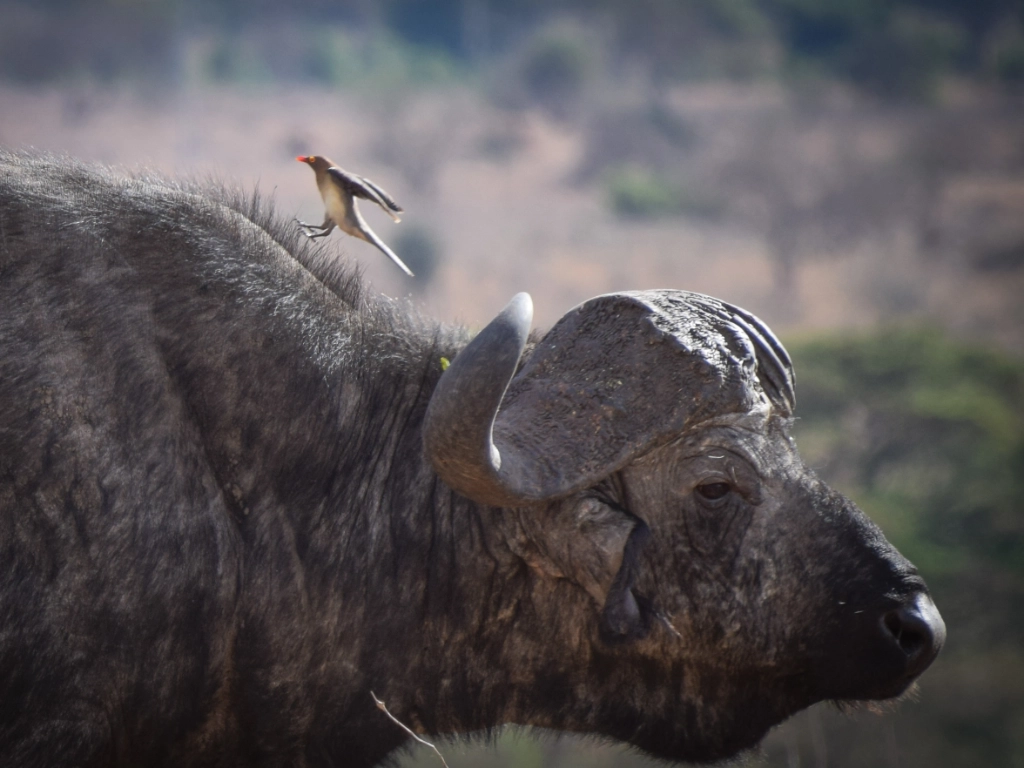
Kenya is the cradle of safari. The “Big Five” — lion, elephant, leopard, buffalo and rhino — still roam vast, protected ecosystems, and our packages put you right in the middle of them. Depending on the itinerary you choose, your safari might include:
Tsavo West National Park — dramatic volcanic landscapes and the crystal-clear Mzima Springs, alive with hippos and crocodiles
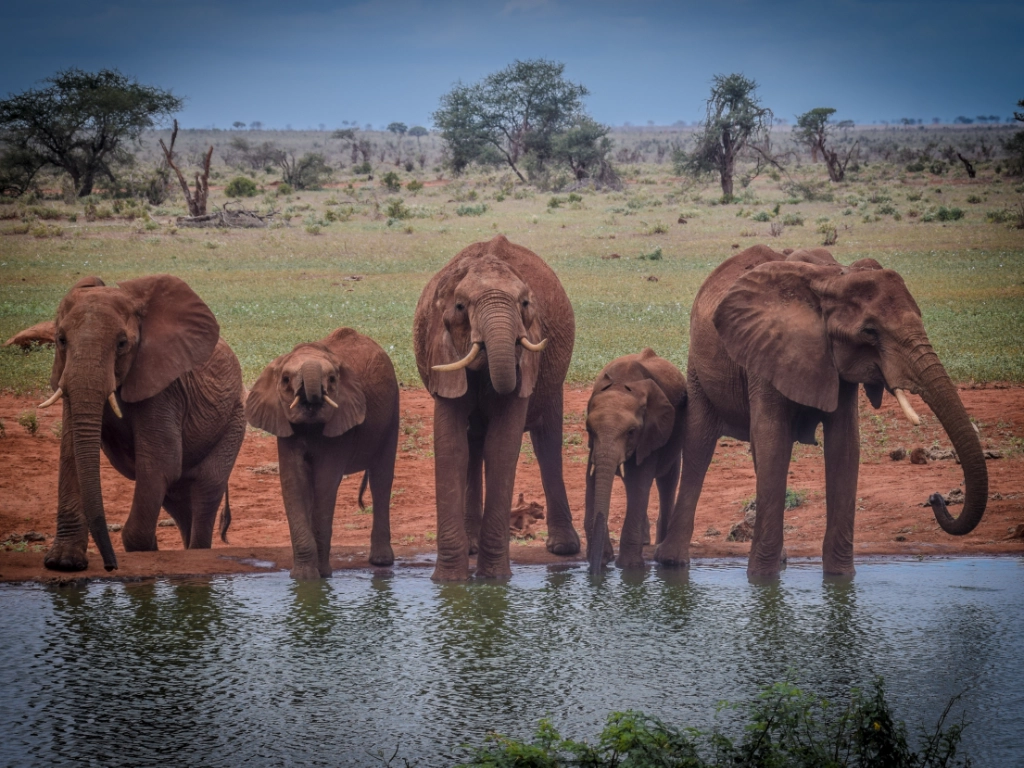
Amboseli National Park — huge elephant herds against the snow-capped backdrop of Mount Kilimanjaro
Masai Mara National Reserve — the world’s most famous game reserve, with optional hot-air balloon flights at sunrise
Lumo Conservancy, Ngutuni & Ziwani — quieter, community-led sanctuaries where elephants drink at your lodge waterhole
Add-ons — gorilla trekking in Rwanda’s Volcanoes National Park, or the star-bed luxury of Loisaba for honeymooners
You’ll travel in a private 4×4 Land Cruiser with a knowledgeable driver-guide, sleep at carefully chosen lodges and tented camps — places like Satao Camp, Ol Tukai Lodge, Severin Safari Camp and Lion’s Bluff — and wake up to game drives at the magical “golden hours” when the bush comes alive.
The Diving — Diani Beach and the Indian Ocean
When the dust of the savannah settles, the road brings you back to Diani Beach on Kenya’s south coast: 17 kilometres of soft white sand, swaying coconut palms and turquoise water that genuinely does look photoshopped. Diani has been ranked among the world’s best beaches year after year, and it’s home base for Ocean Tribe — our main dive centre is located at 41 Beach Club, with an additional booking office inside the Baobab Beach Resort & Spa for guests staying there.
Our diving is as varied as the safari:
Vibrant coral reef dives straight off the Diani coast — turtles on almost every dive, plus schools of reef fish, octopus, moray eels and the occasional reef shark
Wreck dives for those who like a bit of history with their bubbles
Full-day excursions to Kisite Marine National Park — one of East Africa’s premier marine protected areas, with dolphins regularly playing in the bow wave on the way out
Whale shark and manta ray season between December and March — yes, you can snorkel alongside the world’s largest fish
SSI courses from Try Scuba and beginner level right through to Instructor — we’re an SSI Diamond Instructor Training Centre, and we’re proud specialists in adaptive diving for guests with disabilities
Diani Above the Waterline
Diani is more than a dive base. It’s the place where the rest of your trip exhales. Between dives you can kite-surf, take a sunrise microlight flight over the reef, get pampered at the spa, walk through Mombasa Old Town’s Omani architecture, explore the haunting Shimoni Slave Caves, eat fresh Swahili seafood right on the sand, or simply do absolutely nothing in a hammock.
We tailor your stay to suit your style and your wallet. Ocean Tribe arranges accommodation across Diani to match the meal plan and budget you want — from all-inclusive at the renowned Baobab Beach Resort & Spa (80 acres of tropical gardens, three pools, multiple bars and restaurants, nightly entertainment and 500 metres of beachfront), to half-board boutique stays like the Flamboyant, to bed-and-breakfast and self-catering options, right through to private catered villas and beach houses sleeping anywhere from 2 to 10 guests. Tell us what you’re after and we’ll match you to the right place.
Sample Itineraries (a Starting Point — We Build Yours From Scratch)
We don’t believe in off-the-rack holidays. Every Ocean Tribe Dive & Safari package is bespoke, but to give you an idea of what’s possible:
Tsavo East — 7 nights | 1 safari park + 5 days diving (10 dives) — our most popular short option
Tsavo East & Lumo — 9 nights | classic Tsavo plus a community-run sanctuary + 6 days diving
Tsavo & Amboseli — 10 nights | the full southern Kenya safari circuit with Kilimanjaro views + 6 days diving
Masai Mara — 10 nights | fly-in safari to the world’s most famous reserve + 6 days diving
Amboseli & Mara — 13 nights | the ultimate Kenya combination, including optional hot-air balloon flight
Gorillas, Dive & Beach — 10 nights | add mountain gorilla trekking in Rwanda to your dive trip
Honeymoon Safari, Dive & Beach | Masai Mara river suites, Loisaba star beds and Diani — built for two
Every package includes private 4×4 transport with driver-guide, full-board safari accommodation, all national park fees, AMREF emergency-evacuation registration, daily dive trips with equipment rental, transfers, a dive guide on every dive, fresh fruit on the boat and your own Ocean Tribe water bottle and t-shirt to take home.
Bringing a Group? Dive Schools, Clubs and Beyond
Running a dive school, a club, a university trip or a corporate adventure? Large groups are absolutely our thing. We regularly host dive schools and clubs from Europe, the Middle East and beyond, and we know how to scale a Kenyan adventure without losing the personal touch.
For group bookings we’ll work directly with the trip leader to design a fully bespoke package — multiple dive boats running in parallel, dedicated SSI instructors and dive guides for your group, accommodation blocks held across one or several properties to fit your budget mix, private safari vehicles in convoy, group meal plans, custom certification or speciality course tracks, and special pricing for organisers and assistants. Whether you’re bringing 8 divers or 80, hit us up early and we’ll build the trip around your numbers, dates and ambitions.
Best Time to Book a Kenya Dive and Safari Package
Peak diving season runs November to March. Notably, this coincides with whale shark and manta ray sightings. Plus excellent visibility on the reef. Safari, however, is brilliant year-round. In particular, the Great Migration crossings in the Mara peak July to October. That said, we generally don’t recommend diving in May and June. During those months, the long rains can affect sea conditions. So plan around them if diving is the main draw.
There’s a reason divers around the world consistently rank the SSI Diver Stress and Rescue course as the single most rewarding program they’ve ever completed. It isn’t just another card to slot into your logbook. It’s the course that quietly transforms how you think, how you breathe, and how you behave underwater — and it’s the one course every serious diver should take.
If you’ve already earned your Open Water certification and are starting to ask, “What’s next?” — the answer is almost always stress and rescue.
Why Stress and Rescue Matters More Than You Think
Every dive begins with excitement. But beneath the surface, small problems can become big ones fast. A regulator free-flow. A lost buddy. A leg cramp at the surface. A diver who’s suddenly breathing too quickly and losing control.
These moments don’t usually announce themselves. They build — and the difference between a near-miss and a serious incident often comes down to one thing: whether someone in the water recognized the early signs and reacted calmly.
That’s the entire premise of the SSI Diver Stress and Rescue specialty. You learn to spot stress before it becomes panic, manage problems before they escalate into emergencies, and respond confidently when something genuinely goes wrong — for yourself, your buddy, or a stranger on the dive boat.
What You’ll Actually Learn
The SSI Diver Stress and Rescue program is built around three connected pillars: knowledge development, confined-water (pool) training, and open-water scenarios. Together they cover the skills that turn a competent diver into a capable one.
You’ll learn to identify the early physical and behavioral signs of stress, both above and below the surface. You will practice approaching and calming a panicked diver without becoming a second casualty. You’ll rehearse surface rescues, in-water tows, and unconscious-diver recovery protocols. You will work through emergency ascent techniques, gear-related problem solving, and simulated rescue scenarios that mirror the situations you might actually encounter on a real dive.
The training typically spans about 10–15 hours, with pool sessions first and then a minimum of three open-water dives down to a maximum of 18 metres / 60 feet. By the end, the skills aren’t theoretical — they’re muscle memory.
The Confidence Upgrade Every Diver Feels
Ask anyone who has finished the course and you’ll hear the same thing: their diving felt different afterward. Sharper. More aware. More relaxed.
That’s the hidden gift of stress and rescue training. While you’re learning to help others, you’re also learning to read yourself — your breathing rate, your trim, your air consumption, your buddy’s cues, the conditions around you. You stop being a passenger on the dive and become an active participant in its safety.
The result is a diver who is simply nicer to be in the water with. The buddy everyone wants on their team. The diver who notices the small thing before it becomes the big thing.
Who It’s For
The course is open to anyone aged 12 or older who holds an Open Water Diver certification (or equivalent from another agency) and has valid First Aid and CPR training within the last two years. If you don’t yet have that emergency-response background, SSI’s React Right course pairs perfectly with stress and rescue — many dive centres bundle the two into a single 3–4 day Rescue Diver package, giving you CPR, first aid, AED, and oxygen-provider training alongside your in-water skills.
It’s the natural next step for new divers who want to grow with intention, for experienced divers who want to feel more capable, and for anyone considering a future as a Divemaster or Instructor — where stress and rescue is a non-negotiable prerequisite.
Why It Unlocks Your Future in Diving
Beyond the immediate skills, completing the SSI Diver Stress and Rescue specialty opens doors. It’s a required stepping stone toward Advanced Open Water, Master Diver, and every professional certification beyond that — Divemaster, Assistant Instructor, and Open Water Instructor. If you’re even casually considering turning your passion into a career, this is the course that puts you on the path.
But even if your goals are purely personal, the value is just as real. You’ll dive with more peace of mind. You’ll be the diver your friends trust. And you’ll carry skills that — should the unlikely moment ever arrive — could genuinely save a life.
The Bottom Line
The SSI Diver Stress and Rescue course is challenging, hands-on, and unexpectedly fun. It’s also the single biggest leap most divers ever make in confidence, awareness, and capability.
If you love diving, take this course. Do you want to keep diving safely for the rest of your life? Take this course. If you want to be the kind of diver other people want to dive with — take this course.
It really is the one course every serious diver should take.
Quick facts
Duration: approximately 10–15 hours / typically 3 days
Minimum age: 12
Maximum training depth: 18 m / 60 ft
Prerequisites: SSI Open Water Diver (or equivalent) + current First Aid and CPR (e.g. SSI React Right) within the last two years
Certification: SSI Diver Stress and Rescue Specialty — recognised worldwide, valid for life
Frequently Asked Questions
What is the SSI Diver Stress and Rescue course?
It’s an advanced specialty course designed to teach divers how to prevent and manage diving emergencies. You’ll learn to recognise stress in yourself and others. Avoid accidents before they happen. Confidently handle real-world rescue scenarios both at the surface and underwater.
Who can take the course?
You’ll need to be at least 12 years old. Hold an SSI Open Water Diver certification (or equivalent from another agency). Have current First Aid and CPR training within the last two years. Be physically capable of completing the in-water skills.
Do I need any other training first?
Yes — valid First Aid, CPR, and oxygen-provider training is required. The easiest way to tick that box is to take the SSI React Right course alongside Stress and Rescue. Many dive centres bundle the two together as a complete Rescue Diver package.
How long does the course take?
The course typically runs over 3-4 days and takes 10–15 hours in total. A standard schedule looks like: Day 1 — orientation and React Right / theory, Day 2 — pool training and beach scenarios, Day 3 — open-water boat scenarios.
What topics are covered?
You’ll cover identifying and managing stress in divers, emergency management and equipment use, rescuing panicked and unresponsive divers, emergency ascent techniques, first aid and CPR skills, and simulated rescue scenarios.
How deep will I dive during the course?
Open-water training is conducted to a maximum depth of 18 metres / 60 feet, with at least three open-water dives.
Is there a written exam?
Yes. You’ll take a 25-question final exam and need a minimum score of 88% (no more than three incorrect answers) to pass.
What certification will I receive?
On successful completion, you’ll earn the SSI Diver Stress and Rescue Specialty certification, which is recognised worldwide and valid for life.
Is the course difficult?
It’s challenging but achievable — that’s part of what makes it so rewarding. The skills are introduced step by step, first in theory, then in the pool, then in open water, so you build confidence at each stage before progressing to realistic scenarios.
How does this course help my future diving?
It’s a key prerequisite for professional-level training such as SSI Dive Guide and Divemaster, and it counts toward your Advanced Open Water and Master Diver recognition levels. Even if you have no professional ambitions, it dramatically improves your awareness, confidence, and ability to dive safely for the rest of your life.
Why do divers say it’s the most rewarding course they’ve taken?
Because it changes how you dive. You finish the course more aware, more relaxed, and more capable — the kind of diver other divers genuinely want as a buddy.
Wondering how to crossover to SSI from PADI? You are not alone. More dive pros than ever are making the switch, and once you look at the costs, the materials and the long-term career benefits, it is easy to see why. The good news is that the process is straightforward, respects the experience you already have, and does not require you to start over from scratch.
This is a step-by-step guide on how to crossover to SSI from PADI, what to expect at Ocean Tribe in Diani Beach, Kenya, and why so many pros are calling it the upgrade their career needed.
Why Crossover to SSI in the First Place?
Before you book anything, it is worth understanding what you are actually upgrading to. SSI (Scuba Schools International) is one of the largest and fastest-growing diver training agencies in the world, with over 3,800 dive centres in more than 140 countries. The system is fully digital, the materials are modern, and the pricing structure is built to keep working pros earning rather than constantly paying.
For PADI pros, the headline reasons to crossover usually come down to four things:
Lower costs, both upfront and on annual renewal.
Greater teaching flexibility — SSI lets you adapt the order of skills to suit your students rather than locking you into a rigid sequence.
Better materials — SSI Wetnotes and the MySSI app replace the bulky stack of plastic slates and printed manuals.
The Pro Rewards system — you earn points every time you certify a diver, and those points come straight off your renewal fee.
When dive pros ask how to crossover to SSI, the answer depends on the rating you already hold. SSI recognises your training and uses the crossover to bring you up to speed with the SSI philosophy, standards and teaching system, rather than putting you through everything you have already done.
There are two main pathways, depending on where you are in your career.
If You Are a PADI Divemaster
You do not need a separate “Divemaster crossover” pathway. PADI Divemasters are welcome to enrol directly in the SSI Instructor Training Course (ITC) at Ocean Tribe. Your existing Divemaster training and dive experience count towards the prerequisites, just as they would on a PADI IDC. If you simply want to switch your professional affiliation to SSI Divemaster first, that can be arranged in a short orientation programme as well — get in touch and we will walk you through which option suits you best.
If You Are a PADI Instructor
This is where the dedicated SSI Instructor Crossover Course comes in. It is a streamlined programme designed specifically for instructors who already hold a rating with another recognised agency and want to add SSI to their teaching credentials, or move across entirely.
At Ocean Tribe, the Instructor Crossover typically runs over two to four days, depending on your current status and recent teaching experience. After the academic and in-water sessions, you will intern alongside our experienced SSI Instructor team, assisting with real Open Water Diver students. You then attend a two-day Instructor Evaluation (IE), and once you pass that, you are officially an SSI Open Water Instructor.
The Instructor Crossover is open to certified instructors from WRSTC agencies, including PADI, NAUI, CMAS, SDI, TDI, IANTD and BSAC. Both active and inactive instructors are welcome, provided your inactive period has not exceeded five years. If it has been longer than that, you will need to reactivate under SSI standards first or take the full SSI Instructor Training Course instead.
A couple of important rules:
You must not be involved in any ongoing quality assurance proceedings with another agency.
Candidates who have been expelled from another agency are not eligible.
If you are under investigation or involved in any compliance issue, full disclosure to SSI is required before you enrol.
You will also need to be at least 18 years old, hold a current instructor certification, and have valid First Aid, CPR and oxygen provider certifications.
What You Need Before You Start
Before your crossover begins, there is a small amount of admin to take care of. None of it is difficult, and our team will guide you through every step.
Upload copies of your current instructor certifications and professional documents into the MySSI system.
Register for the appropriate SSI professional certifications.
Purchase the relevant crossover materials (these are included in the Ocean Tribe package — more on cost below).
Bring your usual instructor kit. If you are unsure about any equipment requirements, just message us in advance.
What You Will Learn
The crossover is not about retraining you as a diver or as a teacher. You already are one. The programme is about getting you fluent in the SSI way of doing things, so you can step straight into a teaching role and feel confident on day one.
You will cover:
SSI’s educational philosophy and how it shapes the way you deliver courses.
SSI teaching standards and operational procedures.
How to safely and effectively conduct SSI programs that match the qualifications you already hold.
Use of the MySSI app and the digital teaching tools that come with it.
The structure of SSI Wetnotes and how they replace the traditional slate system.
SSI typically expects a stronger academic grounding and a slightly broader set of in-water skills than some other agencies, so the crossover will make sure you are comfortably meeting those standards. The whole experience is designed to be supportive and enjoyable, building on the foundation you already have.
How Much Does the Crossover Cost?
The full SSI Instructor Crossover Course at Ocean Tribe is $2199, and that includes:
The SSI Instructor Crossover Course itself
The SSI Instructor Evaluation (IE)
The Instructor Digital Crewpack and SSI teaching Wetnotes
The SSI Professional Mask Strap
Dive Briefing and Dive Guide Evaluation Slate
The SSI Professional Application Fee
For PADI Instructors comparing this to the cost of starting a fresh IDC at another centre — typically over USD $4,000 once you add the course, crew pack, IE and application fees — the crossover is one of the most affordable ways to add a major teaching credential to your CV.
How Much Will You Save Year on Year?
The savings do not stop with the course. As an SSI pro, your annual renewals are significantly lower than the PADI equivalent.
PADI Divemaster renewal: around $250 per year. SSI Divemaster: $85.
PADI Instructor renewal: around $430 per year. SSI Instructor: $190 (and that includes React Right Instructor status).
That is roughly $240 saved every year as an Instructor and $165 a year as a Divemaster, before you even factor in the SSI Pro Rewards points you earn for every certification you issue. Every 200 points knocks $20 off your next renewal, and many of our active instructors cover their renewal entirely this way.
Can I Hold Both PADI and SSI Pro Ratings?
Yes. It is perfectly possible to be both a PADI Instructor and an SSI Instructor at the same time, which is useful if you work at a centre that offers both, or if you freelance between multiple operators. Bear in mind that if you do hold both, you will be paying two professional renewal fees each year. At the higher levels of Master Instructor and Instructor Trainer, you will need to pick one agency to teach for.
What Happens After You Crossover?
Once you have completed the crossover and passed the Instructor Evaluation, you are an SSI Open Water Instructor — and you can immediately teach a long list of SSI programs, including:
Try Scuba Diving / Basic Diver
Scuba Diver
Open Water Diver
Advanced Adventurer
Perfect Buoyancy
Diver Stress and Rescue
Divemaster, including Dive Guide and Science of Diving
Computer Diving
Enriched Air Nitrox
Marine Ecology
Adding new specialties later is straightforward. You only pay for the relevant Digital Instructor Guide ($58) — there is no separate application fee, and upgrades to higher pro levels happen automatically and free of charge once you meet the requirements.
A Word from Our Instructor Trainer
We made a deliberate decision at Ocean Tribe to build our pro pathway around SSI. I was an active PADI Course Director for 17 years, so it was not a decision I took lightly. SSI’s flexible teaching philosophy lets us tailor training to the strengths and needs of each candidate rather than follow a rigid checklist. The materials are more modern and practical, the costs are lower, and the long-term benefits — the Pro Rewards system, the reduced renewals, the global network of dive centres — make it easier for our graduates to actually build a sustainable career. The crossover is the easiest way for an existing PADI pro to come and see for themselves.
— Mark, SSI Instructor Trainer, Ocean Tribe
Bottom Line: How to Crossover to SSI the Easy Way
Knowing how to crossover to SSI is one thing — actually doing it is one of the smartest career moves a working dive professional can make. You keep everything you have already earned, you save thousands across your career in course fees, renewals and specialty applications, and you step into a modern, digital, globally connected agency that is actively looking for more qualified instructors.
If you are ready to upgrade your pro status, the next step is simple. Have a look at the SSI Instructor Crossover Course, then drop us a message on WhatsApp at +254 700 934 854 or contact the Ocean Tribe team directly. We will help you confirm your eligibility, get your MySSI paperwork lined up, and book you onto the next available crossover at our base in Diani Beach, Kenya.
Learning how to crossover to SSI is not just about saving money — it is about building a stronger, more flexible foundation for the rest of your diving career.