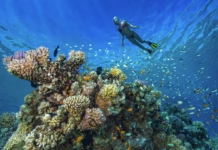
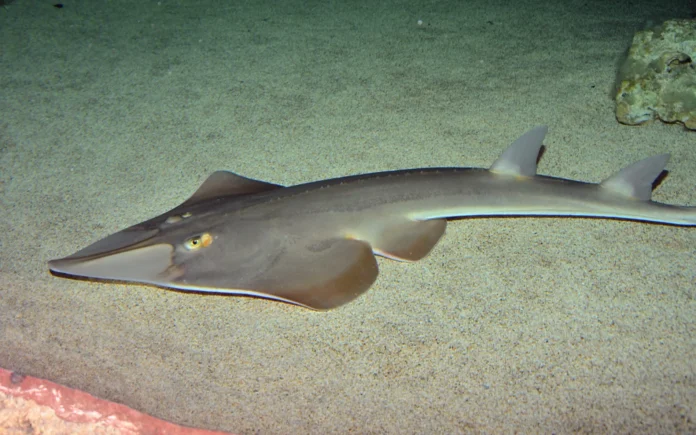
Guitar rays, also known as guitarfish, are one of the ocean’s most curious hybrids—combining the flat body of a ray with the sweeping tail of a shark. Divers in Diani Beach, Kenya are sometimes lucky enough to encounter these bottom-dwelling creatures gliding across sandy flats or resting near coral reefs. But what exactly are guitar rays, and why are they worth watching out for?
What Is a Guitar Ray?
Guitar rays belong to the ray family Rhinobatidae, a group often referred to as shovelnose rays. With a long, flattened snout, wing-like pectoral fins, and a muscular tail, their silhouette closely resembles a guitar—hence the name[^1].
They typically grow to about 1.5–1.8 meters in length, although some species remain smaller. Their backs are sandy brown or olive, mottled for camouflage against the seabed, while their undersides are pale. Though closely related to rays, they swim like sharks, using their tails in a side-to-side motion rather than flapping their fins[^2].
Where Do Guitar Rays Live?
Guitar rays prefer warm, shallow coastal waters, especially tropical and subtropical seas. They thrive over sandy and muddy seabeds, seagrass meadows, and the edges of coral reefs[^3].
In East Africa, and particularly around Diani, these habitats are found in abundance. The Diani–Chale Marine Reserve offers a combination of fringing coral reefs, sandy channels, and seagrass beds—an ideal environment for guitar rays to feed and hide[^4].
What Do They Eat?
Guitar rays are bottom feeders, using their keen senses and flattened bodies to detect prey buried in sand. Their diet includes:
- Crustaceans like crabs and shrimp
- Mollusks, including clams and snails
- Small bottom-dwelling fish
- Worms and other invertebrates
They often forage by stirring up sand with their fins or lying in ambush, waiting for prey to pass by[^5].
Behaviour and Daily Life
Guitar rays are typically solitary and shy. During the day, they rest motionless on the seabed, partially buried. At night, they become more active, foraging under the cover of darkness.
Unlike stingrays, they do not possess venomous barbs and are generally harmless to divers. While they may appear elusive, patient observers may see one gliding slowly away if gently approached[^6].
How Do Guitar Rays Reproduce?
Guitar rays reproduce through internal fertilisation, with females giving birth to live young after a long gestation period. This method, called ovoviviparity, involves embryos developing in eggs inside the mother’s body until they hatch and are born.
- Gestation lasts around 10–12 months.
- Litter sizes are small—between 2 and 12 pups.
- No parental care is provided after birth.
Due to their slow reproductive cycle and low birth rates, guitar rays are especially vulnerable to population declines[^7].
Are They Endangered?
Many species of guitar rays are now considered threatened or endangered. The IUCN lists several as Vulnerable, Endangered, or Critically Endangered, largely due to:
- Overfishing, both targeted and as bycatch
- Habitat destruction from coastal development and pollution
- Low reproductive rates, making population recovery slow
Some guitarfish are even caught for their fins, which are sold in international shark-fin markets[^8].
Guitar Rays in Diani, Kenya
Diani’s reef and sandscape make it one of the best places in Kenya to see guitar rays. The marine reserve’s protected status and rich biodiversity increase the likelihood of sightings, especially in sandy channels between coral outcrops or during night dives.
Local dive operators, including Ocean Tribe, report occasional sightings of resting guitar rays, particularly in deeper reef areas or near seagrass beds. Their ability to camouflage makes them easy to miss—but extremely rewarding to find[^4].
Why You Should Care
Guitar rays may not be as famous as manta rays or whale sharks, but they’re just as remarkable. As indicator species, their presence tells us about the health of coastal marine ecosystems. Seeing one on a dive is a special moment—and a reminder of why marine protection matters.
Next time you’re diving in Diani, keep an eye on the sand—you might just spot a shadow that looks a little like a shark, a little like a ray… and completely unforgettable.
References
[^1]: Last, P.R., et al. (2016). Rays of the World. CSIRO Publishing.
[^2]: Compagno, L.J.V. (2002). Sharks of the World. FAO Species Catalogue.
[^3]: McEachran, J.D., & de Carvalho, M.R. (2002). Biology of Skates and Rays.
[^4]: Kuria, M. & Eijkelenboom, G. (2019). Diani–Chale Marine Reserve Biodiversity Report. Kenya Marine and Fisheries Research Institute.
[^5]: Smith, M.M. & Heemstra, P.C. (1986). Smiths’ Sea Fishes.
[^6]: Ocean Tribe Dive Log Archives, 2022–2024.
[^7]: IUCN Red List. (2023). Rhinobatos spp. Retrieved from iucnredlist.org
[^8]: Dulvy, N.K., et al. (2021). Overfishing Threatens Sharks and Rays. Nature, 589, 233–237.